Introduction
Across the rich tradition of Bengali folklore, few characters are as beloved as Gopal Bhar. Renowned for his quick wit, sharp humor, and extraordinary presence of mind, Gopal has entertained generations of readers and listeners while quietly teaching timeless lessons about wisdom, justice, humility, and human nature.
Although much of his life is woven into legend, Gopal Bhar is traditionally believed to have served in the court of King Krishnachandra of Nadia during the eighteenth century. Unlike powerful ministers or learned scholars, Gopal possessed no great wealth or official authority. His greatest strength was his intelligence. With clever reasoning, humor, and an uncanny understanding of people, he solved disputes, exposed hypocrisy, humbled the arrogant, and often guided the king toward wiser decisions.
The stories of Gopal Bhar are far more than humorous anecdotes. Beneath their laughter lie enduring reflections on honesty, fairness, compassion, common sense, and the importance of questioning appearances. His wit challenged pride, defended the innocent, and reminded people that true wisdom is measured not by status or riches, but by clarity of thought and strength of character.
Like the tales of Nasreddin Hodja, Birbal, and Tenali Raman, the adventures of Gopal Bhar have traveled across generations through oral storytelling before finding their place in books. Over time, different versions of the same stories have emerged, each preserving the spirit of a man whose intelligence was his greatest weapon.
Gopal Bhar Retold presents these timeless classics in modern English for today’s readers while preserving the warmth, humor, and wisdom of the original Bengali tradition. Each story has been carefully retold to remain engaging for contemporary audiences without losing its cultural roots.
Whether you are discovering Gopal Bhar for the first time or revisiting a cherished childhood memory, these stories offer more than entertainment. They invite us to laugh, to think, and to remember that wisdom often speaks with a smile.
Welcome to the remarkable world of Gopal Bhar—where every story ends with a lesson, every laugh carries meaning, and every clever answer reveals a deeper truth.
Episode 1: The Praise of the Eggplant
Setting the Scene
Wit is not merely the art of making people laugh—it is the art of revealing truth through laughter.
Among the countless tales of Gopal Bhar, the legendary court jester of eighteenth-century Bengal, this is one of the most beloved. With a single clever remark, Gopal exposes a timeless human weakness: the tendency to agree with those in power.
The Praise of the Eggplant
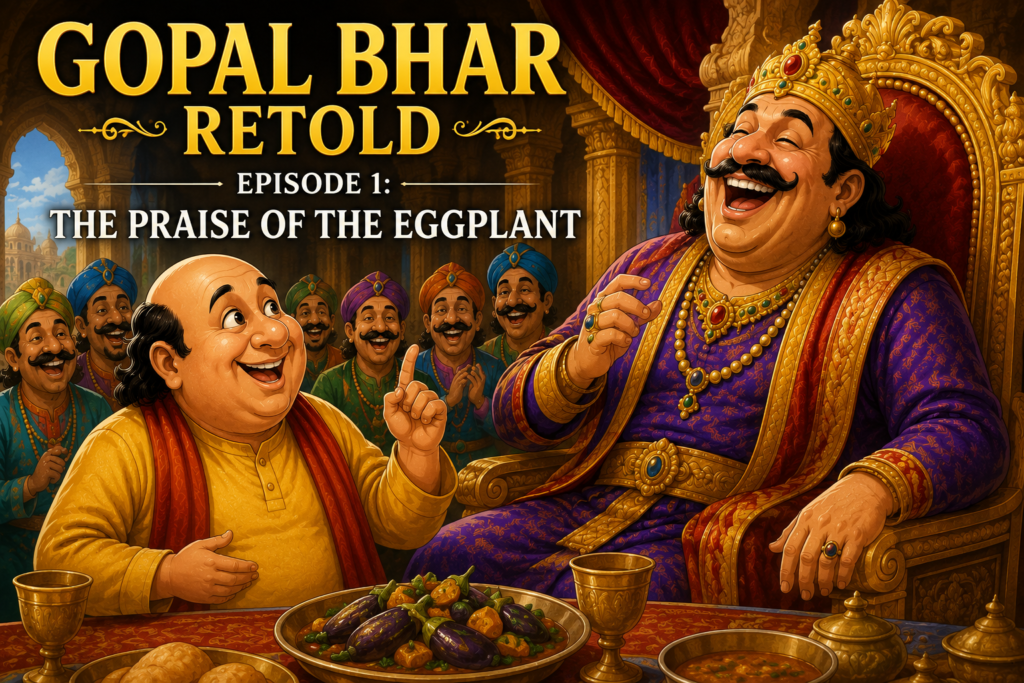
One day, King Krishnachandra was enjoying a lavish royal feast. Among the many dishes served, a preparation of eggplant delighted him the most.
Turning to his courtiers, the king asked,
“Tell me, is there any vegetable finer than the eggplant?”
Without hesitation, Gopal Bhar stepped forward and replied,
“Your Majesty, the eggplant is truly the king of vegetables. It is delicious, versatile, and unmatched in its qualities.”
The king smiled with satisfaction, pleased that Gopal shared his opinion.
A few days later, another feast was held. Once again, an eggplant dish appeared on the royal table. This time, however, the cook had prepared it poorly. After tasting it, the king frowned.
“What a dreadful vegetable!” he exclaimed. “There is hardly anything good about it.”
Without missing a beat, Gopal nodded.
“Your Majesty is absolutely right. The eggplant is indeed a most ordinary and disappointing vegetable.”
The king looked at him in astonishment.
“Gopal! Only a few days ago you praised the eggplant as the greatest of all vegetables. Now you condemn it. Which is the truth?”
With a gentle smile, Gopal bowed and replied,
“Your Majesty, I am your servant—not the eggplant’s.”
For a moment the court fell silent.
Then the king burst into laughter, and the entire royal court echoed with amusement.
Reflection
Power often inspires agreement more readily than honesty. Through humor, Gopal Bhar reminds us that flattery may win favor, but it also reveals the fragile nature of human loyalty. The tale remains as relevant today as it was centuries ago, inviting us to laugh—and perhaps to question ourselves.
Episode 2: Gopal Bhar and the Thief
Setting the Scene
True intelligence is often revealed not in moments of comfort, but in moments of danger. Gopal Bhar never relied on force to overcome his enemies. Instead, he turned wit into his greatest weapon.
This classic tale shows how a calm mind can triumph over dishonest intentions.
Gopal Bhar and the Thief
Late one night, a thief quietly slipped into Gopal Bhar’s house.
Lying awake in bed, Gopal realized that someone was searching through the rooms in the darkness. He remained perfectly calm. Rather than raising an alarm, he spoke loudly enough for the intruder to hear.
“My dear,” he said to his wife, “it isn’t safe to keep money inside the house anymore. So I’ve hidden all our savings in an iron chest at the bottom of the well behind the house.”
The thief’s eyes sparkled with excitement.
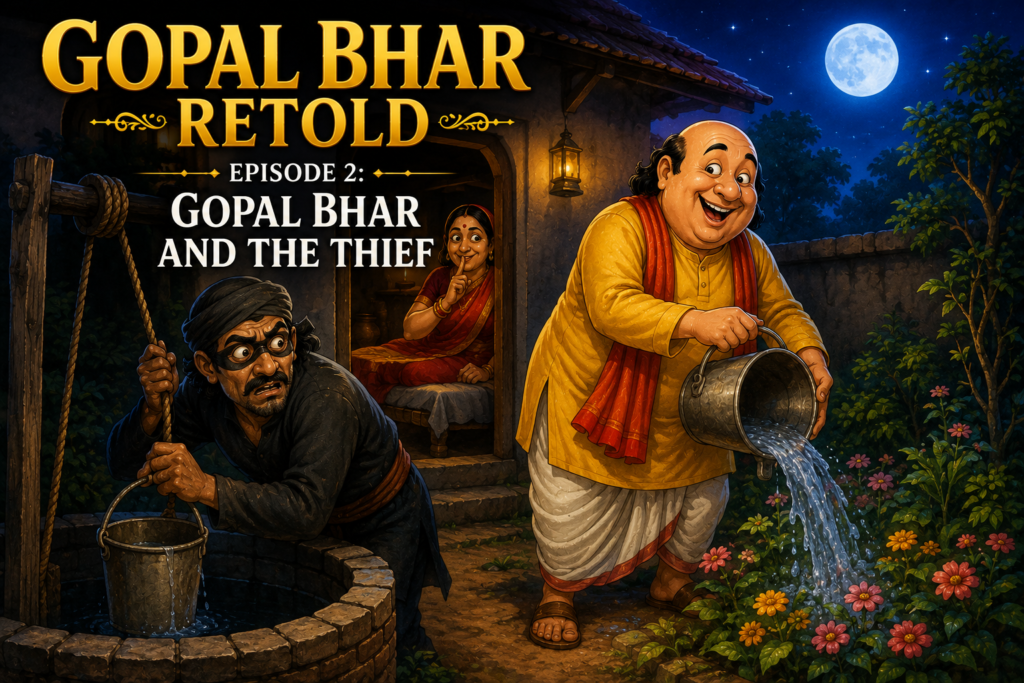
As soon as the house fell silent again, he hurried to the well. Grabbing a bucket, he began drawing out water, convinced that the hidden chest would soon appear.
Meanwhile, Gopal quietly got out of bed. Carrying bucket after bucket, he used the water to irrigate his garden.
The thief worked tirelessly throughout the night, emptying water from the well, while Gopal happily watered every tree and flower in his yard.
By dawn, the exhausted thief realized he had been deceived. There was no iron chest—only an endless supply of water.
Gopal smiled and said,
“My friend, thank you for watering my garden. You have saved me a great deal of work.”
Ashamed and completely outwitted, the thief fled without a word.
Reflection
Strength may overpower an opponent for a moment, but wisdom defeats them without a fight. Gopal Bhar reminds us that presence of mind is often the most powerful defense against deception.
Episode 3: The King’s Dream
Setting the Scene
A clever mind can turn even an attempt at ridicule into a moment of triumph.
In this timeless tale, King Krishnachandra tries to amuse his court at Gopal Bhar’s expense. But Gopal’s quick wit transforms the joke into one that everyone—including the king—must laugh at.
The King’s Dream
One morning, King Krishnachandra entered the royal court wearing a mysterious smile.
“My friends,” he announced, “I had a most curious dream last night.”
The courtiers leaned forward with interest.
“In my dream,” the king said, “Gopal and I were walking together. Suddenly, I fell into a pond filled with sweet rice pudding, while Gopal fell into a pit full of cow dung.”
The court erupted in laughter.
The king turned to Gopal and asked with amusement,
“Well, Gopal, what do you think of my dream?”
Gopal bowed respectfully.
“Your Majesty, what a remarkable coincidence! I had the very same dream.”
The king raised an eyebrow.
“Did you? Then tell us—what happened next?”
Gopal replied calmly,
“We both managed to climb out. But there was no water nearby to wash ourselves. So, Your Majesty cleaned me by licking me, and I cleaned you in the same way.”
For a moment, the entire court fell silent.
Then the king realized that his own joke had been turned against him. Unable to contain himself, he burst into laughter, and soon the whole court echoed with cheerful applause and amusement.
Reflection
Those who mock others should be prepared to laugh at themselves. Gopal Bhar teaches us that true wit does not rely on anger or revenge—it answers ridicule with intelligence, humor, and perfect timing.
Episode 4: Gopal Bhar and the Proud Scholar
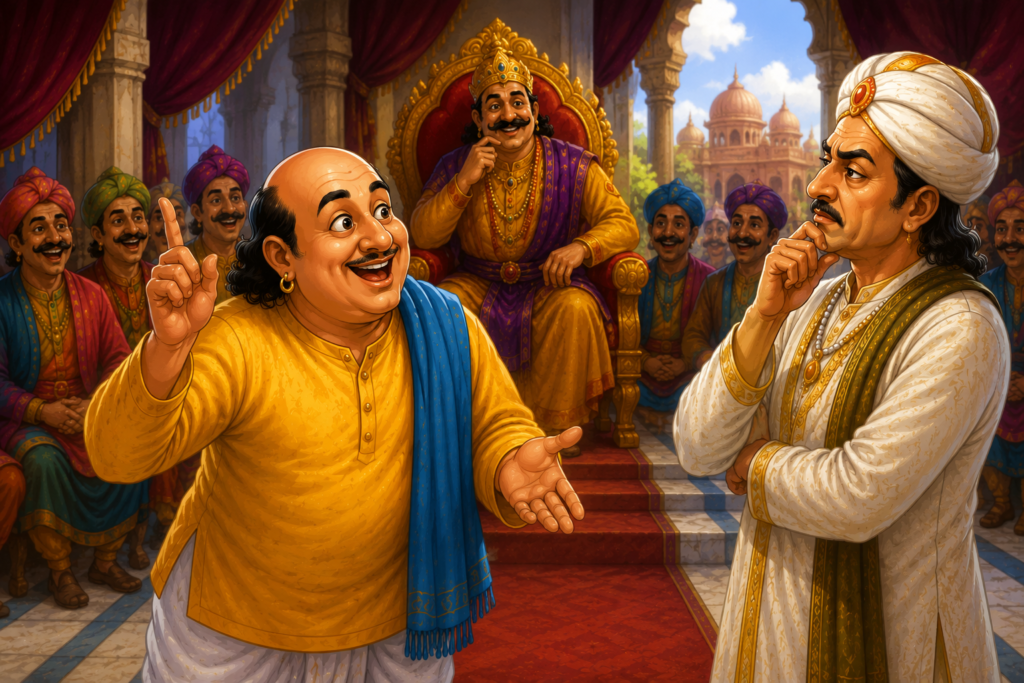
Setting the Scene
Knowledge is valuable, but wisdom is greater.
A person may master countless books and still fail to understand life. Gopal Bhar knew that true intelligence is measured not by how much we know, but by how wisely we think and speak.
Gopal Bhar and the Proud Scholar
One day, a renowned scholar from a distant land arrived at the court of King Krishnachandra.
With great pride, he announced,
“Is there anyone in this kingdom who can defeat me in a debate?”
The royal court fell silent. No one wished to challenge the learned man.
The king glanced at Gopal Bhar.
Gopal rose with a smile.
“Respected Scholar,” he said, “before we begin, may I ask you a simple question?”
“Certainly,” replied the scholar confidently.
Gopal asked,
“What is the fastest thing in the world?”
The scholar answered without hesitation.
“The wind.”
Gopal shook his head.
“No.”
“The speed of light?”
“No.”
“The human mind?”
Again Gopal smiled.
“Not even the mind.”
The scholar frowned.
“Then what is faster?”
Gopal replied,
“The human tongue. It often speaks before the mind has had the chance to think.”
For a moment, the court was silent.
Then laughter filled the royal hall.
The scholar lowered his head with a respectful smile.
“Today,” he admitted, “I have learned that true wisdom is not found only in books. It also lives in the presence of mind.”
King Krishnachandra applauded Gopal’s wit and rewarded him before the entire court.
Reflection
Knowledge without humility often becomes pride. Wisdom, however, speaks with simplicity, thinks before it speaks, and leaves others richer than before.
Episode 5: Gopal Bhar and the Miser’s Treasure
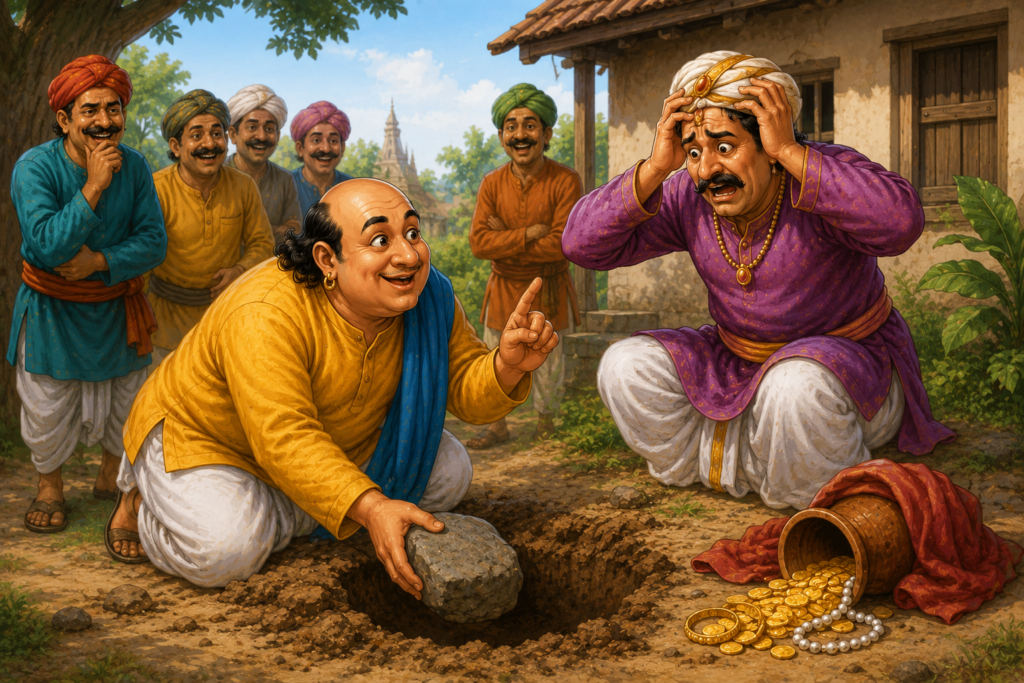
Setting the Scene
Wealth has value only when it is put to good use.
Gold locked away in fear serves no one—not even its owner. In this classic tale, Gopal Bhar uses a simple stone to teach a wealthy miser a lesson that remains timeless.
Gopal Bhar and the Miser’s Treasure
There once lived a wealthy man in Nadia.
Although he possessed great riches, he was so miserly that he refused to spend even a single coin—not on himself, nor on anyone else.
Fearing that someone might steal his fortune, he placed all his gold and silver in a large earthen pot and buried it behind his house.
Every morning he would uncover the spot, look at the pot with satisfaction, and bury it again before returning home.
A thief soon noticed this strange routine.
One night, under the cover of darkness, he dug up the pot and disappeared with the treasure.
The next morning, when the miser found the hole empty, he cried out in despair and beat his chest in grief.
Hearing the commotion, Gopal Bhar came to see what had happened.
“What is the matter?” he asked.
“My life’s savings have been stolen!” the man wailed.
Gopal calmly asked,
“Did you ever spend that money?”
“Never.”
“Did you lend it to anyone in need?”
“No.”
“Did you use it for any good purpose?”
“Not at all.”
Without another word, Gopal picked up a large stone and placed it inside the empty hole.
The miser stared at him in disbelief.
“What are you doing?”
Gopal smiled.
“Think of this stone as your treasure. Since you never used your wealth, this stone is worth exactly as much to you as the gold that was buried here. Come every morning and look at it—it will serve the same purpose.”
The villagers burst into laughter.
The miser lowered his head in silence, finally realizing that unused wealth is no better than a stone buried in the ground.
Reflection
Wealth is meaningful only when it benefits life. Money that is never used, never shared, and never invested in good deeds is merely a burden hidden beneath the earth.
Episode 6: Gopal Bhar and the Disputed Mango Tree
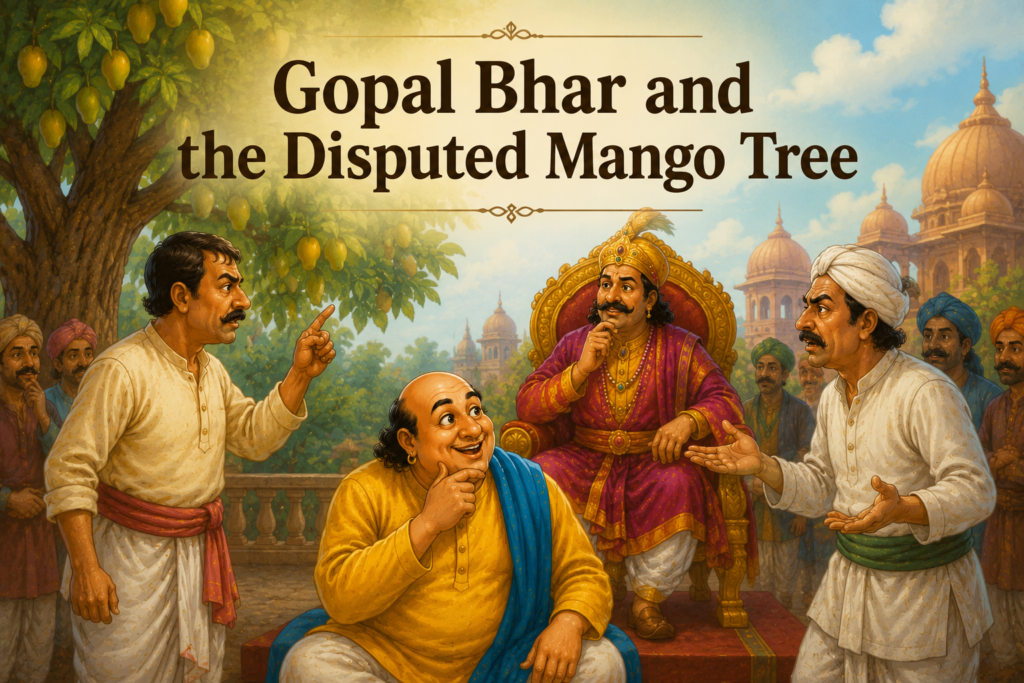
Setting the Scene
Justice is not always found in written laws. Sometimes, the simplest test reveals the deepest truth.
When words failed to settle a dispute, Gopal Bhar relied on human nature itself—and uncovered the rightful owner with remarkable wisdom.
Gopal Bhar and the Disputed Mango Tree
One day, two neighbors appeared before the court of King Krishnachandra.
Both claimed ownership of the same mango tree.
The first man declared,
“Your Majesty, the tree is mine. I planted it many years ago.”
The second immediately objected.
“No, Your Majesty. The tree stands on my land, and I have always cared for it.”
The king questioned them at length, but neither man’s story could be proven.
Finally, he turned to Gopal Bhar.
“Gopal,” he said, “this case is yours to decide.”
Gopal listened quietly, then sent both men home without giving a verdict.
That night, he secretly instructed one of his trusted men to spread a rumor throughout the village.
“Thieves are planning to steal all the mangoes from that tree tonight.”
The news quickly reached both neighbors.
The first man shrugged and said,
“It is already late. I’ll see what happens in the morning.”
The second man grabbed a stick and rushed out at once to guard the tree.
The following morning, Gopal summoned both men back to the royal court.
With a gentle smile, he announced,
“The true owner is the one who could not bear the thought of the tree being harmed. Real ownership is shown through care, not merely through claims.”
King Krishnachandra nodded in approval and awarded the mango tree to the second man.
The court praised Gopal once again for his wisdom.
Reflection
Love reveals ownership more clearly than words. A person who truly values something protects it, even when no one is watching. Responsibility is often the strongest proof of possession.
Episode 7: Gopal Bhar and the Taste of Milk
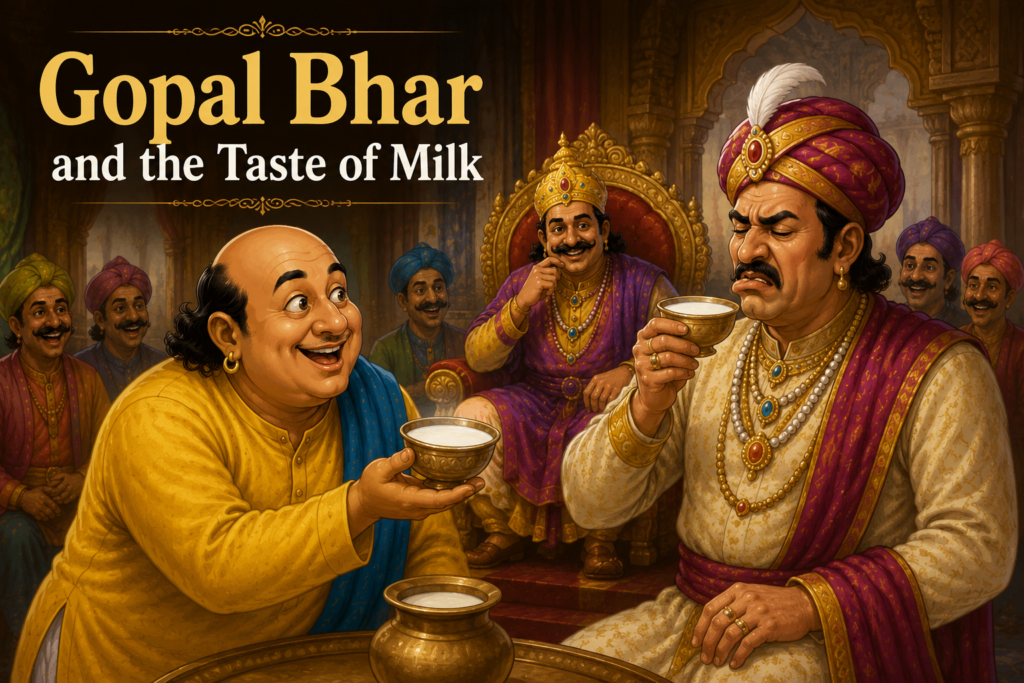
Setting the Scene
True excellence needs no advertisement.
People often boast about what they possess, believing that words can increase its worth. But genuine quality speaks for itself. In this delightful tale, Gopal Bhar teaches a proud nobleman that real value is recognized by experience, not by loud claims.
Gopal Bhar and the Taste of Milk
One day, a wealthy landlord visited the court of King Krishnachandra.
Unable to hide his pride, he declared,
“Your Majesty, nowhere in the world will you find milk as delicious as the milk from my cows.”
The king smiled politely.
“Is that so?”
The landlord continued confidently,
“Anyone who tastes it even once will never wish to drink any other milk again.”
Gopal Bhar listened quietly without saying a word.
The following day, he invited the landlord to his home for a meal.
After dinner, Gopal brought him a bowl of milk.
The landlord took a sip, frowned, and immediately put the bowl down.
“What is this? This milk is terrible!”
Gopal smiled gently.
“How did you know?”
The landlord looked surprised.
“I could tell from its taste.”
“Exactly,” Gopal replied. “The finest things never need boasting. Their quality speaks for itself.”
The lesson soon reached the royal court.
King Krishnachandra laughed heartily and said,
“Gopal, once again you have defeated pride with wisdom.”
The landlord lowered his head in embarrassment, realizing that empty boasting can never replace genuine excellence.
Reflection
Quality never depends on loud praise. What is truly excellent earns admiration naturally, while arrogance often exposes its own emptiness.
Episode 8: Gopal Bhar and the Royal Feast

Setting the Scene
Greed has an unusual nature—it grows even as it is being satisfied.
Contentment, on the other hand, comes not from abundance but from self-control. In this delightful tale, Gopal Bhar exposes the true face of greed with a single witty remark.
Gopal Bhar and the Royal Feast
One day, King Krishnachandra hosted a magnificent feast at the royal palace.
Scholars, noblemen, landlords, ministers, and distinguished guests from across the kingdom were invited to attend.
As the banquet began, everyone enjoyed the delicious food with dignity and moderation.
Everyone—except one wealthy guest.
He continued piling dish after dish onto his plate, eating far more than anyone else at the table.
Gopal Bhar watched the scene quietly.
When the feast was over, the king looked around with satisfaction and asked,
“I trust everyone has enjoyed the meal?”
The guests nodded gratefully.
At that moment, Gopal rose to his feet.
“Your Majesty,” he said, “there is still one person here who remains hungry.”
The hall fell silent.
The king looked surprised.
“Who could that be?”
Gopal smiled and pointed gently toward the wealthy guest.
“The gentleman who ate the most. If he were truly satisfied, why would he have kept taking more and more food?”
For a moment, the court was speechless.
Then laughter echoed through the royal hall.
The embarrassed guest lowered his head, while King Krishnachandra laughed heartily.
“Gopal,” the king said, “once again you have revealed a great truth with a single sentence.”
Reflection
Greed is never satisfied. The more it receives, the more it desires. True fulfillment comes not from consuming more, but from knowing when enough is enough.
Episode 9: Gopal Bhar and the Price of a Fragrance
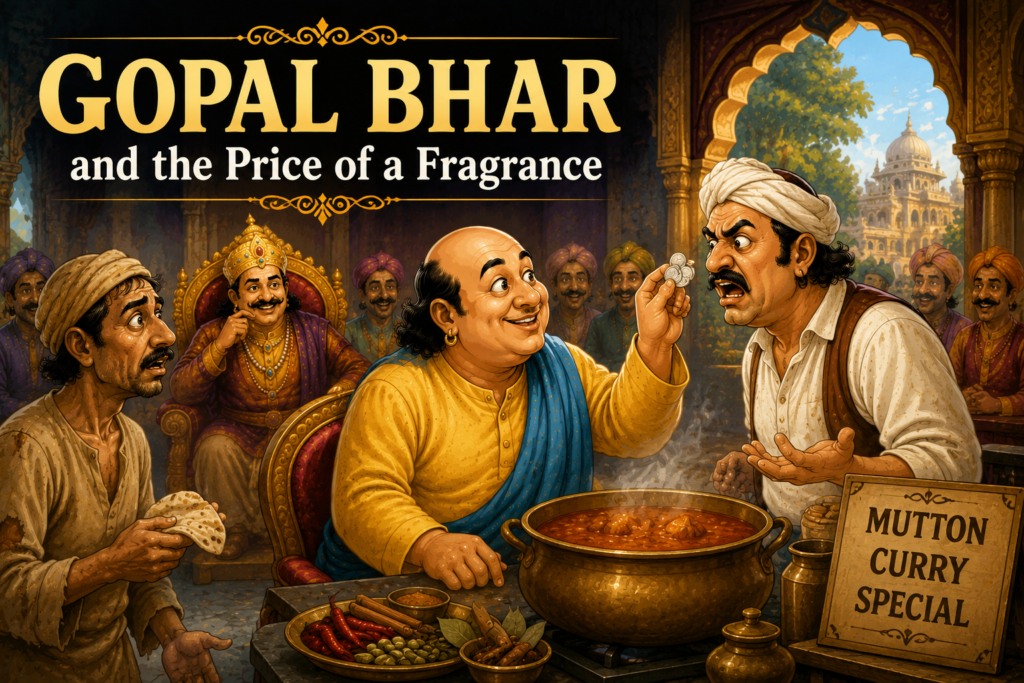
Setting the Scene
Can the aroma of food be bought and sold?
This timeless folktale answers that curious question with wit, justice, and humor. When greed disguises itself as fairness, Gopal Bhar reminds us that true justice often requires imagination as much as reason.
Gopal Bhar and the Price of a Fragrance
One day, a poor traveler was passing through a busy marketplace.
The only food he carried was a piece of dry bread.
As he walked by an inn, the rich aroma of freshly cooked mutton curry drifted from the kitchen. Smiling, he held his bread near the steaming pot and ate it while enjoying the delicious fragrance.
The innkeeper noticed what he had done.
Furious, he stopped the traveler and demanded,
“You have enjoyed the aroma of my food. You must pay for it!”
The poor man was astonished.
“But I never touched your food,” he replied. “I only smelled it.”
The innkeeper refused to listen.
The dispute eventually reached the court of King Krishnachandra, who asked Gopal Bhar to settle the matter.
After hearing both sides, Gopal turned to the traveler.
“Do you have any coins with you?”
The traveler reached into his pouch and handed him a few small coins.
Gopal took the coins, held them close to the innkeeper’s ear, and shook them so that they rang loudly.
Clink… clink… clink…
Then he returned the coins to the traveler.
“The case is settled,” Gopal announced.
The innkeeper protested.
“What about my payment?”
Gopal smiled.
“You demanded payment for the fragrance of your food. In return, you have received the sound of his money. The account is perfectly balanced.”
For a moment, the courtroom was silent.
Then King Krishnachandra burst into laughter, followed by the entire court.
Even the innkeeper had no answer.
Reflection
Justice is not always measured in coins. Sometimes, the fairest answer is one that exposes greed through wit. Gopal Bhar reminds us that intelligence can achieve what anger never can.
Episode 10: Gopal Bhar and the King’s Ring
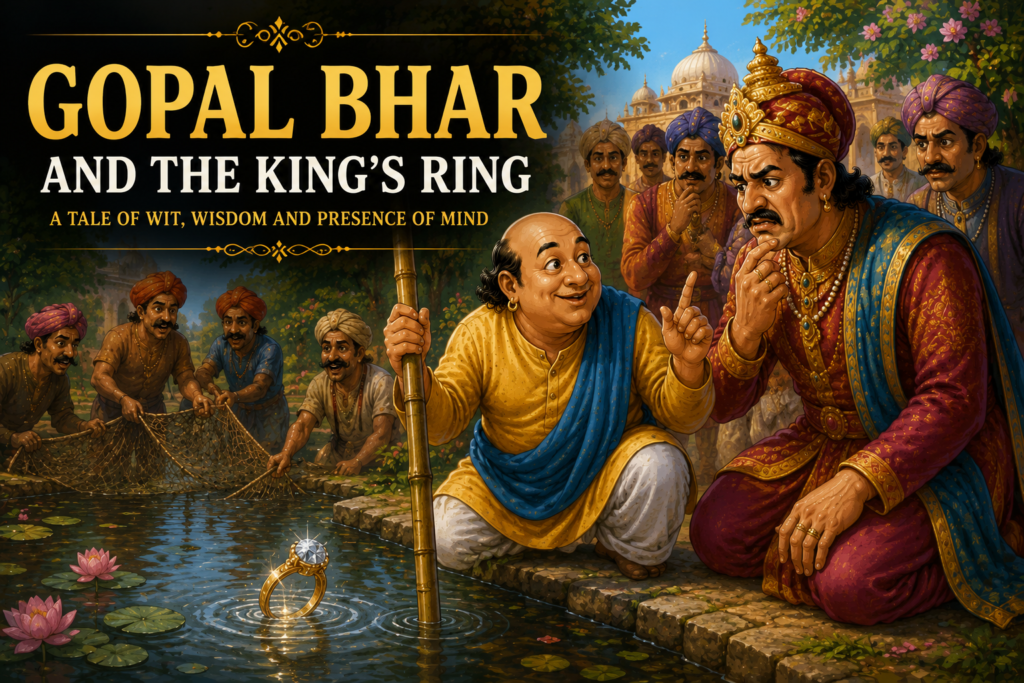
Setting the Scene
Panic rarely solves a problem.
When others lose their composure, the wisest person is often the one who pauses, observes, and thinks. In this charming tale, Gopal Bhar proves that patience and presence of mind can succeed where haste fails.
Gopal Bhar and the King’s Ring
One pleasant morning, King Krishnachandra was strolling through the palace gardens.
As he admired the blooming flowers and the tranquil pond, his precious diamond ring slipped from his finger and disappeared into the water.
The king immediately ordered his guards, servants, and courtiers to search for it.
They looked everywhere.
They searched the banks.
They peered into the water.
But the ring was nowhere to be found.
The disappointed king sighed.
“Have I lost it forever?”
Just then, Gopal Bhar arrived.
After hearing what had happened, he quietly walked to the edge of the pond and carefully observed the place where the ring had fallen.
Without saying a word, he took a long bamboo pole and planted it into the water at that exact spot.
The king looked puzzled.
“Gopal, what good will that do?”
Gopal smiled.
“Nothing today, Your Majesty. But by tomorrow morning, the water will be much clearer. This bamboo will mark the exact place where the ring lies.”
The next morning, fishermen were summoned.
Casting their net precisely where the bamboo stood, they searched only that small area.
Within minutes, the king’s diamond ring was caught in the net.
The king’s face lit up with delight.
“Gopal,” he exclaimed, “once again your wisdom has accomplished what everyone else’s effort could not.”
Gopal bowed respectfully.
“Your Majesty, many problems are solved not by greater strength, but by remembering the right place and waiting for the right moment.”
Reflection
Wisdom is often quiet. Instead of rushing into action, it observes, remembers, and acts with patience. A calm mind can find solutions that panic will never discover.
Episode 11: Gopal Bhar and the Barber
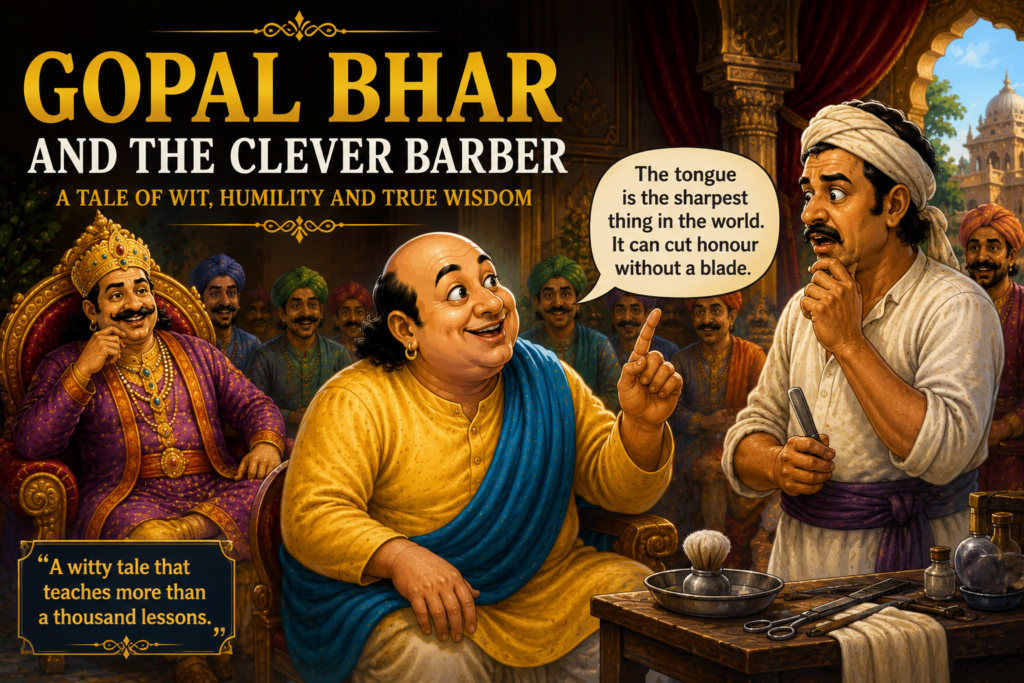
Setting the Scene
There is a great difference between cleverness and wisdom.
Many people boast about their intelligence, yet true wisdom is quiet, humble, and thoughtful. In this classic tale, Gopal Bhar teaches that pride often defeats itself.
Gopal Bhar and the Barber
Among the servants of King Krishnachandra’s court was a barber who took great pride in his own intelligence.
One day, he boldly declared before the entire court,
“There is no one in this kingdom wiser than I am.”
The courtiers burst into laughter.
The king smiled and turned to Gopal Bhar.
“Gopal,” he said, “perhaps it is time we tested our barber’s wisdom.”
The next morning, Gopal invited the barber for a conversation.
“I have heard that you are a man of remarkable intelligence,” Gopal said. “Tell me, what is the sharpest thing in the world?”
The barber answered confidently,
“A sword.”
Gopal shook his head.
“No.”
“A razor?”
“No.”
“A needle?”
Again Gopal smiled.
“No.”
The barber thought for a long while before finally admitting,
“I do not know.”
Gopal looked at him kindly and replied,
“The human tongue is the sharpest thing in the world. Without a blade, it can wound a person’s heart, destroy a reputation, and cut away honour.”
The royal court fell silent.
Then the meaning of Gopal’s words sank in, and the hall filled with laughter and applause.
The barber lowered his head, realizing that his own pride had become his greatest weakness.
King Krishnachandra smiled and said,
“Gopal, today’s lesson is not only for our barber—it is for all of us.”
Reflection
Words are often sharper than weapons. A sword may leave a scar on the body, but careless speech can leave wounds that last a lifetime. True wisdom begins with humility and knowing when to speak—and when to remain silent.
Episode 12: Gopal Bhar and the Fake Astrologer
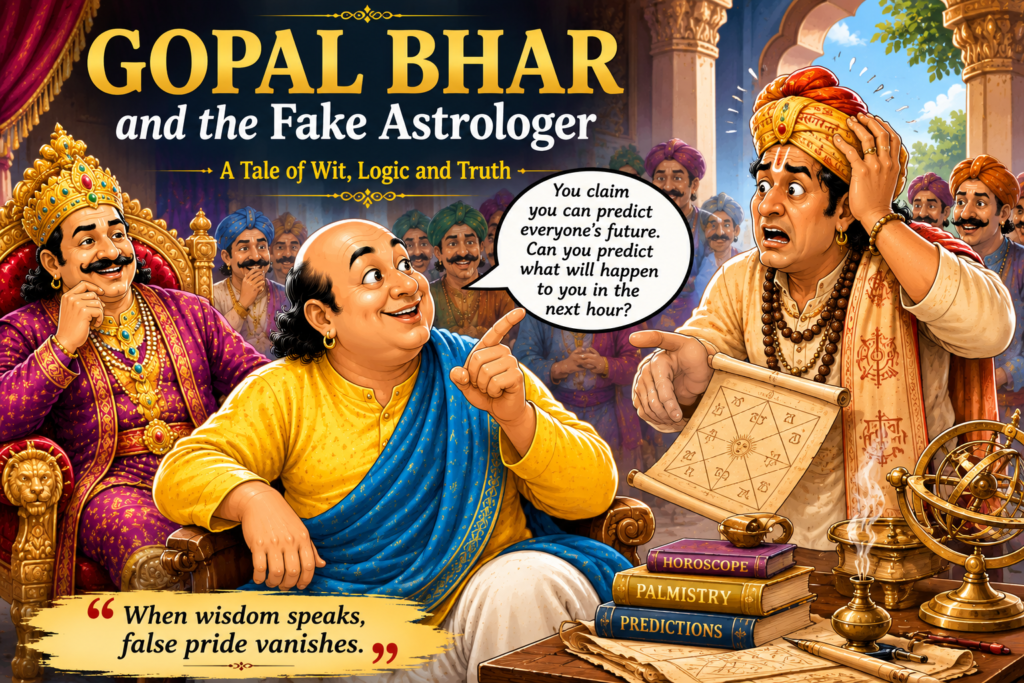
Setting the Scene
People have always been fascinated by those who claim to know the future.
But can someone who cannot foresee their own fate truly predict the destiny of others? In this timeless tale, Gopal Bhar uses logic and wit to expose the emptiness of false claims.
Gopal Bhar and the Fake Astrologer
One day, a famous astrologer arrived at the court of King Krishnachandra.
With great confidence, he proclaimed,
“Your Majesty, I can reveal a person’s past, present, and future.”
Intrigued, the king invited him to demonstrate his skill.
One by one, the astrologer began reading the fortunes of the courtiers.
Some listened in amazement.
Others seemed convinced by his words.
Throughout the performance, Gopal Bhar remained silent.
When the astrologer had finished, Gopal stepped forward.
“If you truly know everything,” he said politely, “may I ask you just one question?”
The astrologer smiled confidently.
“Of course.”
Gopal asked,
“Tell us what will happen to you within the next hour.”
The astrologer closed his eyes, made a show of calculation, and finally declared,
“Today is an exceptionally fortunate day for me. Nothing unpleasant will happen.”
Gopal turned to the king.
“Your Majesty, with your permission, I would like the palace guards to escort this gentleman out of the court immediately.”
The king, amused, nodded.
As the guards approached, the astrologer’s confidence vanished. He stood frozen in disbelief.
Gopal smiled gently.
“You could not foresee what would happen to you within a single hour, yet you claim to predict the course of another person’s entire life.”
The royal court erupted in laughter.
The astrologer lowered his head in embarrassment and quietly left the palace.
King Krishnachandra smiled and said,
“Gopal, today you defeated deception not with force, but with reason.”
Reflection
Extraordinary claims demand careful examination. Wisdom does not rely on grand promises or mysterious predictions—it rests on honesty, reason, and the courage to question what seems too good to be true.
Episode 13: Gopal Bhar and the Greedy Merchant
Setting the Scene
Greed often begins with a lie.
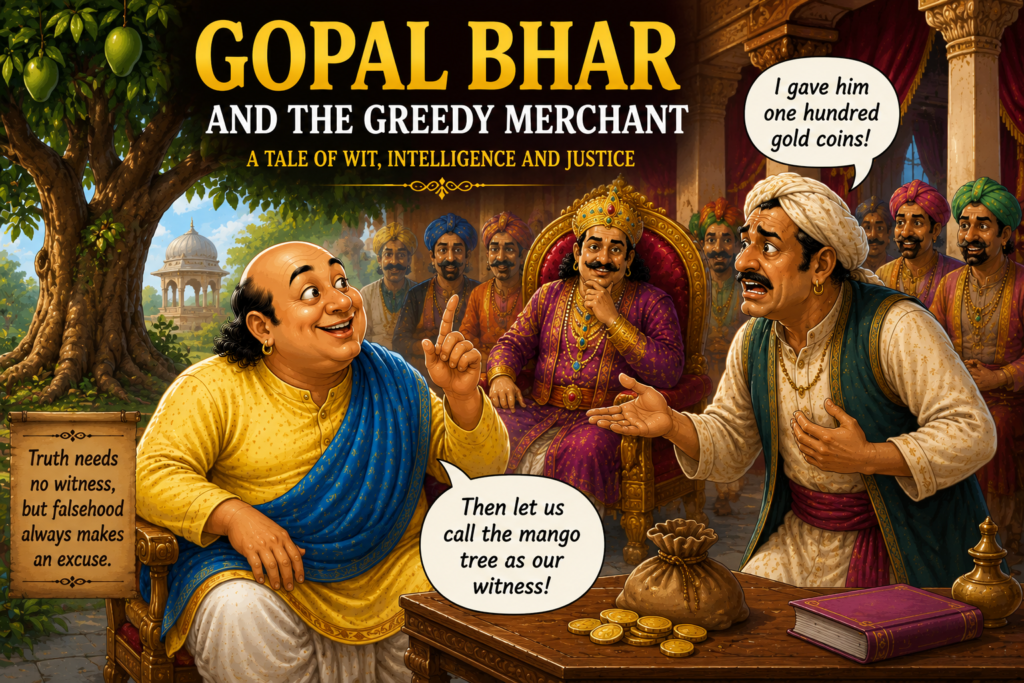
Those driven by greed believe they can deceive others with confidence. Yet truth has a remarkable way of exposing falsehood. In this classic tale, Gopal Bhar solves a difficult case not with evidence alone, but with sharp observation and brilliant reasoning.
Gopal Bhar and the Greedy Merchant
One day, a merchant appeared before the court of King Krishnachandra with a serious complaint.
“Your Majesty,” he said, “Gopal borrowed one hundred gold coins from me and now refuses to repay the debt.”
The king was surprised and immediately summoned Gopal.
Arriving before the court, Gopal calmly replied,
“Your Majesty, I have never borrowed a single coin from this gentleman.”
The merchant insisted,
“I handed him the money myself.”
The king asked,
“Do you have any witnesses?”
“No,” the merchant admitted, “but I gave him the money beneath a large mango tree.”
Gopal smiled.
“In that case, Your Majesty, let us invite the mango tree to appear as our witness.”
The court burst into laughter.
The king smiled.
“Can a tree come to court?”
Gopal answered with a straight face,
“Then let the merchant go and inform the tree that its testimony is required.”
Reluctantly, the merchant left the palace.
After some time had passed, Gopal quietly remarked,
“Your Majesty, he has not yet reached the mango tree.”
The king looked puzzled.
“How could you possibly know that?”
Gopal replied,
“If he had never been to that tree, how could he know how long it would take to get there?”
Just then, the merchant returned.
“The tree refused to come,” he said impatiently.
Gopal smiled.
“So you know exactly where the tree stands. That much is true. But the story about lending me one hundred gold coins is not.”
The merchant stood speechless.
Realizing that his deception had been uncovered, he lowered his head and confessed the truth.
King Krishnachandra praised Gopal’s extraordinary presence of mind and warned the merchant never to make false accusations again.
Reflection
False accusations eventually expose the accuser. Truth does not always require many witnesses; sometimes, careful observation and clear reasoning are enough to reveal it.
Episode 14: Gopal Bhar and the King’s Riddle
Setting the Scene
Not every riddle can be solved with learning alone.
Some questions demand more than knowledge—they require observation, experience, and wisdom. In this delightful tale, Gopal Bhar turns a simple riddle into a profound reflection on human nature.
Gopal Bhar and the King’s Riddle
One morning, King Krishnachandra entered the royal court with a smile.
“Today,” he announced, “I have a riddle. Whoever answers it correctly shall receive a reward.”
The courtiers eagerly waited for the question.
The king asked,
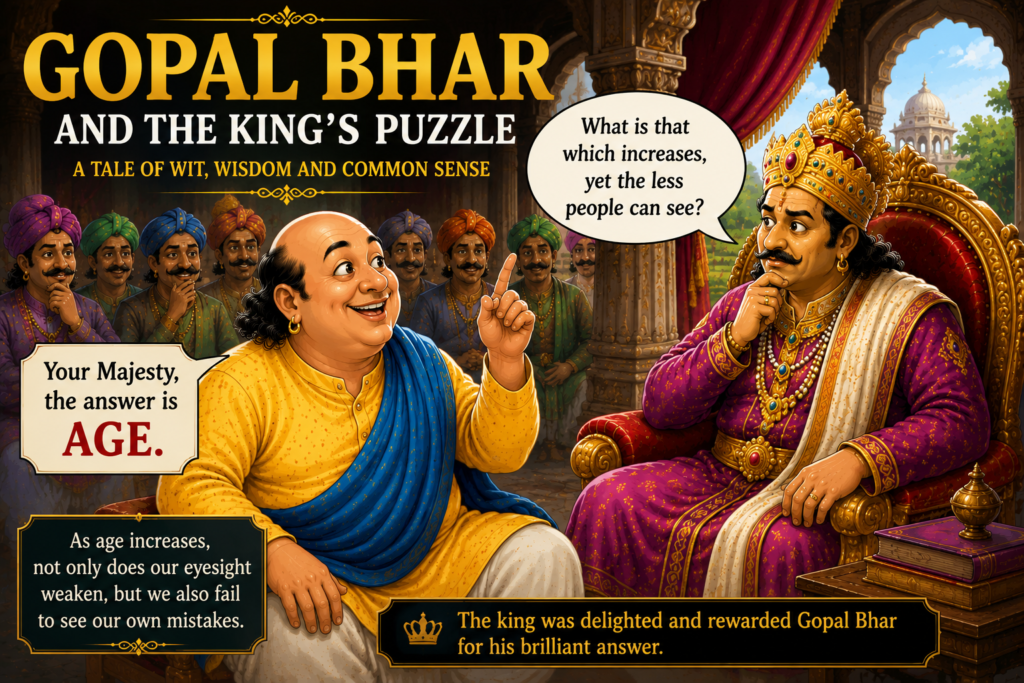
“What is the one thing that increases, yet causes people to see less?”
Immediately, answers began to pour in.
“Fog,” suggested one courtier.
“No,” replied the king.
“Darkness,” guessed another.
“No.”
“Clouds,” offered a third.
The king shook his head once again.
None of the answers was correct.
At last, Gopal Bhar rose from his seat.
“Your Majesty,” he said, “the answer is age.”
The king looked at him with curiosity.
“Explain your answer.”
Gopal smiled.
“As people grow older, their eyesight naturally weakens. But that is not all. With age, many also become less willing to see their own faults.”
The court fell silent.
The king reflected on Gopal’s words for a moment.
Then he broke into a warm laugh.
“Gopal,” he said, “you have not only solved my riddle—you have revealed a truth about life.”
The king immediately rewarded Gopal, and the courtiers applauded his remarkable insight.
Reflection
Wisdom does more than answer questions—it reveals the truths hidden within them. The greatest minds are those that look beyond the obvious and uncover lessons that remain relevant throughout life.
Episode 15: Gopal Bhar and the King’s Promise

Setting the Scene
A promise is more than a few spoken words—it is a measure of one’s character.
Whether made by a king or a commoner, a promise carries the weight of trust. In this delightful tale, Gopal Bhar reminds King Krishnachandra that true greatness lies not in power, but in keeping one’s word.
Gopal Bhar and the King’s Promise
One day, King Krishnachandra was in an unusually cheerful mood.
Smiling at his courtiers, he announced,
“Today, whoever makes me laugh the most shall receive one hundred gold coins.”
Excited by the challenge, the courtiers came forward one after another.
Some told amusing stories.
Others performed comic acts.
A few even imitated famous people.
The king smiled politely, but none of them truly made him laugh.
Finally, Gopal Bhar stepped forward.
He leaned close to the king and whispered a few words into his ear.
Within moments, the king burst into uncontrollable laughter.
The entire court watched in astonishment as tears of laughter filled the king’s eyes.
When the laughter finally subsided, Gopal bowed respectfully.
“Your Majesty,” he said, “may I receive the reward you promised?”
The king, wishing to tease him, replied with a smile,
“I do not remember making such a promise.”
A murmur spread across the court.
Gopal remained calm.
Then he quietly said,
“Your Majesty, if the king’s own word has no value today, whose word will the people trust tomorrow?”
The court fell completely silent.
The king immediately realized the truth in Gopal’s words.
With a warm smile, he said,
“Gopal, once again you have reminded me of my duty.”
He ordered one hundred gold coins to be brought before the court and presented them to Gopal.
Then the king declared,
“A ruler’s greatest ornament is not his crown, but his ability to keep his promise.”
Reflection
Trust is built one promise at a time. Authority may command obedience, but integrity earns respect. A person who keeps their word leaves behind a legacy far greater than wealth or power.
Episode 16: Gopal Bhar and Two Handfuls of Wisdom
Setting the Scene
Wealth can buy comfort, luxury, and influence—but never wisdom.
Many believe that money can solve every problem. Gopal Bhar knew better. In this delightful tale, he reminds us that the greatest treasures in life cannot be bought, no matter how deep one’s pockets may be.
Gopal Bhar and Two Handfuls of Wisdom
One day, a wealthy man appeared before the court of King Krishnachandra.
With great pride, he declared,
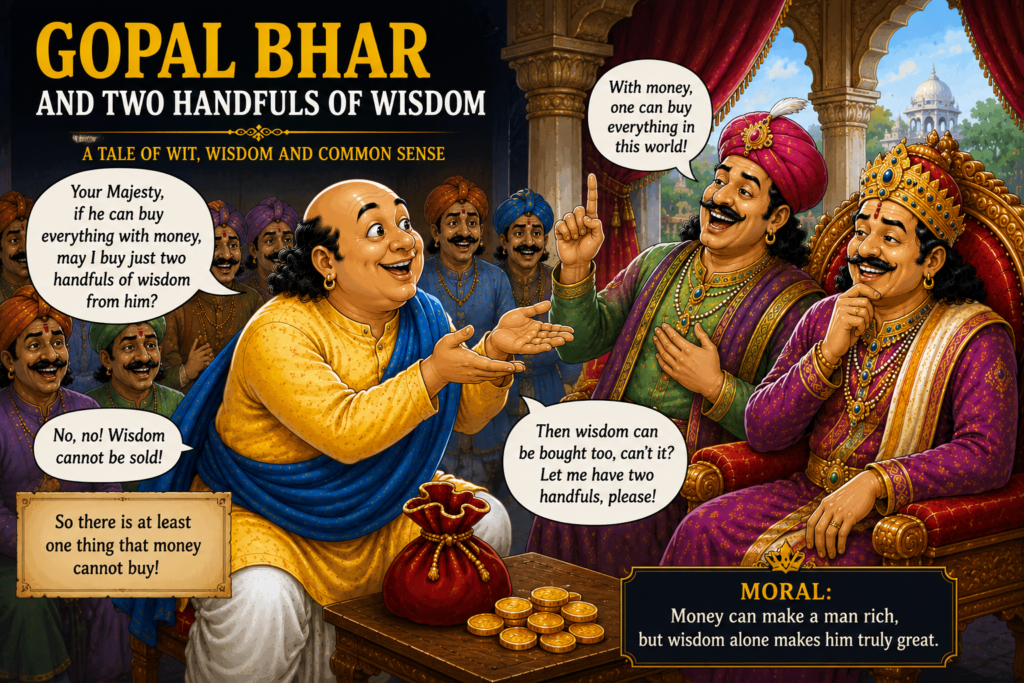
“Your Majesty, money can buy everything in this world.”
The king smiled with curiosity.
“Is that so?”
“Absolutely,” replied the man confidently. “Nothing is impossible for a person with enough wealth.”
Until then, Gopal Bhar had remained silent.
He stepped forward and bowed.
“Your Majesty,” he said, “with your permission, I would like to buy just two handfuls of wisdom from this gentleman.”
The court burst into laughter.
The wealthy man frowned.
“Wisdom cannot be bought or sold.”
Gopal smiled warmly.
“But you just told us that money can buy everything.”
The merchant stood speechless.
“If wisdom cannot be purchased,” Gopal continued, “then your own statement proves itself false. There is at least one thing that wealth can never buy.”
The court echoed with laughter once again.
King Krishnachandra applauded Gopal’s sharp reasoning.
“Gopal,” he said, “today you have reminded us that wisdom is a far greater treasure than gold.”
The wealthy man lowered his head, humbled by the lesson.
Reflection
Money may purchase possessions, but it cannot purchase judgment, wisdom, or character. The richest person is not the one who owns the most, but the one who understands what money can never buy.
Episode 17: Gopal Bhar and the King’s Test
Setting the Scene
The wisest answers are not always born from guessing.
True intelligence lies in observing carefully, thinking logically, and drawing conclusions from evidence rather than assumptions. In this delightful tale, Gopal Bhar demonstrates that sound reasoning is often more valuable than knowledge itself.
Gopal Bhar and the King’s Test
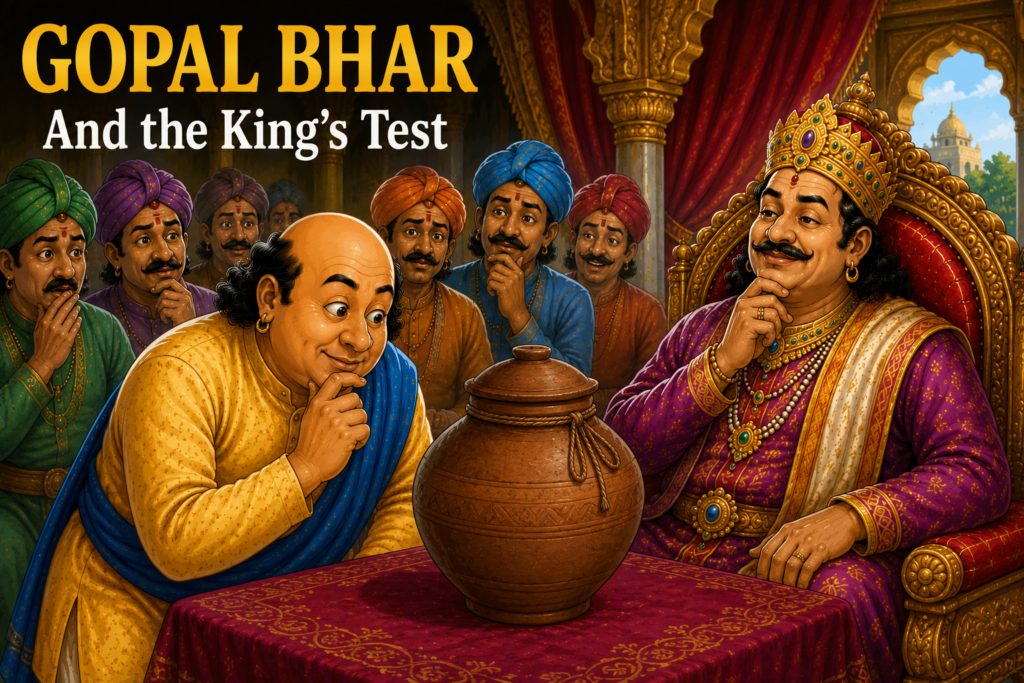
One morning, King Krishnachandra entered the royal court carrying a large sealed earthen pot.
Placing it before the assembled courtiers, he announced,
“Whoever can tell me what is inside this pot—without opening it—shall receive a generous reward.”
The challenge immediately sparked excitement.
One courtier guessed,
“Gold coins.”
Another confidently replied,
“Precious pearls.”
A third suggested,
“Royal jewels.”
The king simply smiled.
None of the answers satisfied him.
Finally, Gopal Bhar stepped forward.
He carefully examined the pot from every side.
He lifted it gently, gave it a slight shake, listened closely, and then placed it back on the table.
After a moment of silence, he said,
“Your Majesty, I cannot tell you exactly what is inside. But I am certain of one thing.”
The king leaned forward with curiosity.
“And what is that?”
“Whatever is inside,” Gopal replied, “it cannot be very valuable.”
The entire court looked astonished.
“How did you reach that conclusion?” the king asked.
Gopal smiled.
“If the pot truly contained something precious, Your Majesty would never have left it in plain sight before the entire court as part of a guessing game.”
For a moment, the hall fell silent.
Then the king laughed with delight.
He removed the lid from the pot.
Inside were nothing more than a handful of dried leaves.
“Gopal,” the king declared, “you did not rely on luck—you relied on reason.”
The court applauded warmly, and the king rewarded Gopal for his remarkable judgment.
Reflection
Anyone can make a guess, but only a thoughtful mind can reach the truth through reason. Wisdom begins where assumptions end and careful observation begins.
Episode 18: Gopal Bhar and the Jealous Courtier
Setting the Scene
Jealousy often blinds people to the truth.
Instead of appreciating another person’s wisdom, many dismiss success as mere luck. In this timeless tale, Gopal Bhar proves that careful observation and thoughtful judgment—not fortune—are the true foundations of success.
Gopal Bhar and the Jealous Courtier
Among the courtiers of King Krishnachandra was a man who could never tolerate Gopal Bhar’s popularity.
Whenever he had the opportunity, he tried to belittle Gopal before the king.
One day, he complained,
“Your Majesty, people praise Gopal far too much. He succeeds only because of good luck.”
The king smiled.
“Very well,” he said. “Let us find out.”
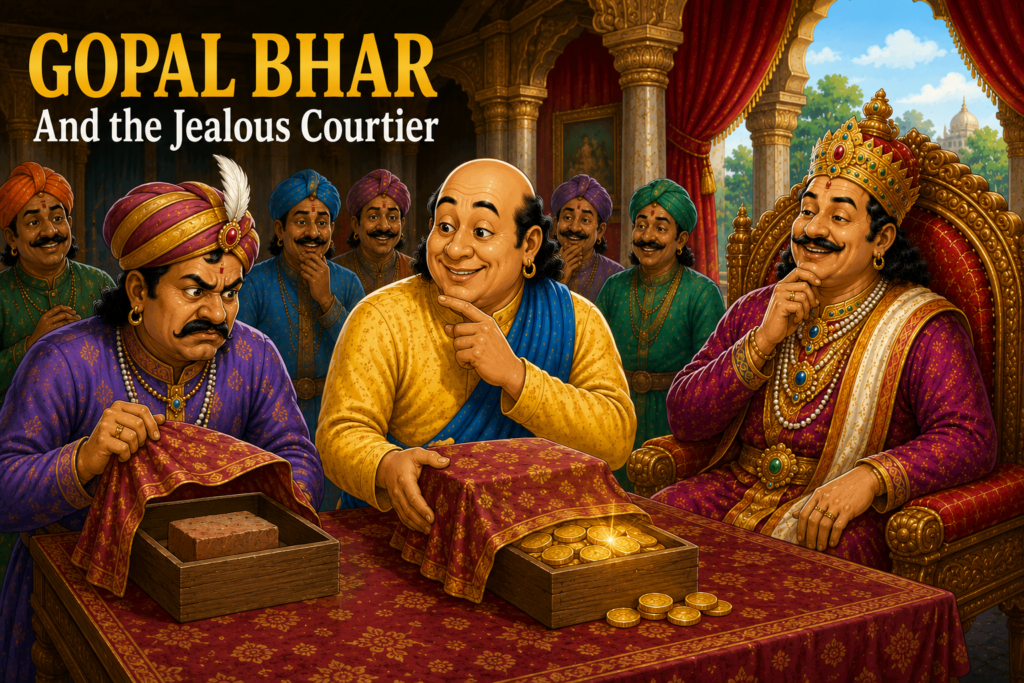
The following day, two identical cloth-covered wooden boxes were placed before the royal court.
Inside one box were gold coins.
Inside the other was nothing more than an ordinary brick.
The king invited both men to choose one box.
The jealous courtier hurried forward and grabbed the first box he saw.
Gopal calmly picked up the other.
“Now,” said the king, “open them.”
The courtier lifted the lid of his box.
Inside lay a single brick.
When Gopal opened his box, bright gold coins glittered before the astonished court.
The jealous courtier protested,
“You see, Your Majesty? It was simply luck!”
Gopal smiled.
“No, it was not luck.”
The king asked,
“Then how did you know which box to choose?”
Gopal replied,
“I did not guess. I lifted both boxes before making my choice. Gold weighs far more than a brick. The heavier box was the obvious answer.”
The royal court burst into laughter.
King Krishnachandra nodded with admiration.
“Once again,” he declared, “people mistake wisdom for luck.”
The jealous courtier lowered his head in embarrassment, realizing that envy had clouded his own judgment.
Reflection
It is easy to call another person’s success ‘luck.’ It is much harder to recognize the patience, observation, and intelligence behind it. Wisdom is rarely accidental—it is earned through thoughtful judgment.
Episode 19: Gopal Bhar and the Impossible Question
Setting the Scene
Some questions are asked not to discover the truth, but to trap the person answering them.
A wise person knows that when a question is impossible, the best response is not a perfect answer—but a perfectly logical one. In this timeless tale, Gopal Bhar demonstrates that wit and reason can outshine impossible challenges.
Gopal Bhar and the Impossible Question
One day, King Krishnachandra looked at Gopal with a playful smile.
“Gopal,” he said, “today I have a special question for you.”
“I am ready, Your Majesty,” Gopal replied.
The king asked,
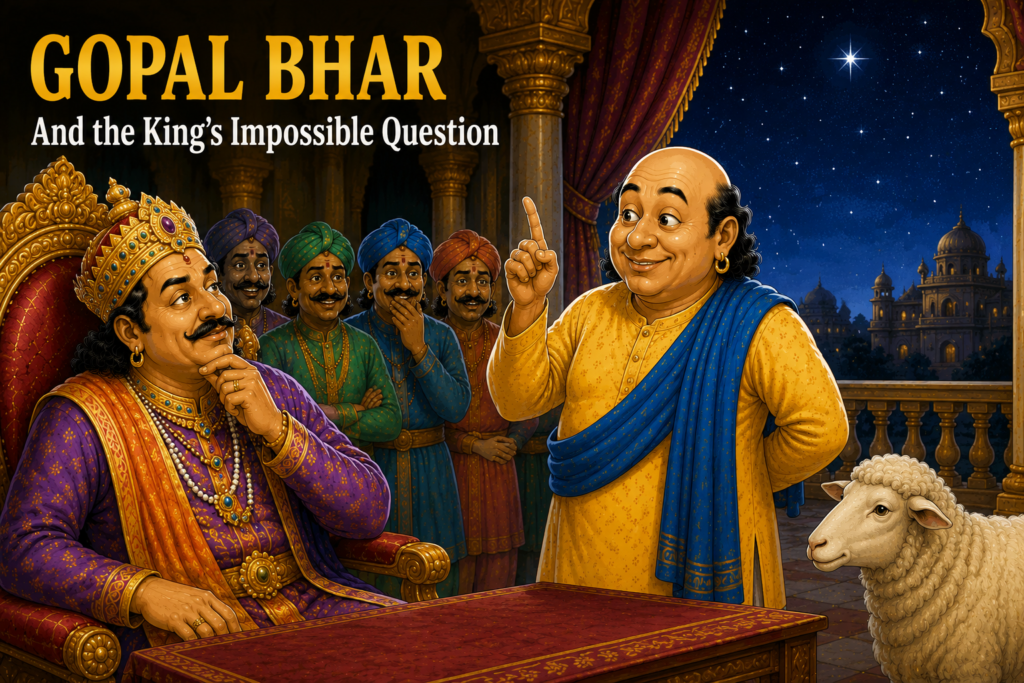
“Tell me, exactly how many stars are there in the sky?”
The entire royal court fell silent.
Everyone turned toward Gopal, eager to hear his answer.
After a brief pause, Gopal smiled.
“Your Majesty, I can certainly answer that.”
The king leaned forward.
“Then tell us.”
Gopal pointed toward a sheep grazing outside the palace window.
“There are exactly as many stars in the sky as there are hairs on that sheep.”
Laughter spread throughout the court.
The king smiled.
“And how will you prove that?”
Without hesitation, Gopal replied,
“If Your Majesty has any doubt, first count every hair on the sheep. After that, I shall count the stars and compare the two.”
The king burst into hearty laughter.
“You have answered an impossible question in the only possible way.”
The courtiers applauded Gopal’s remarkable wit and presence of mind.
Reflection
Not every question deserves a literal answer. Sometimes, the greatest wisdom lies in revealing the absurdity of the question itself. Logic, humor, and confidence often succeed where facts alone cannot.
Episode 20: Gopal Bhar and the King’s Shadow
Setting the Scene
Some challenges are impossible only because we look at them the wrong way.
A wise person does not waste time trying to do the impossible. Instead, they change their perspective and discover a solution that no one else has imagined. This delightful tale perfectly captures Gopal Bhar’s creative brilliance.
Gopal Bhar and the King’s Shadow
One day, King Krishnachandra decided to tease Gopal Bhar.
With a playful smile, he said,
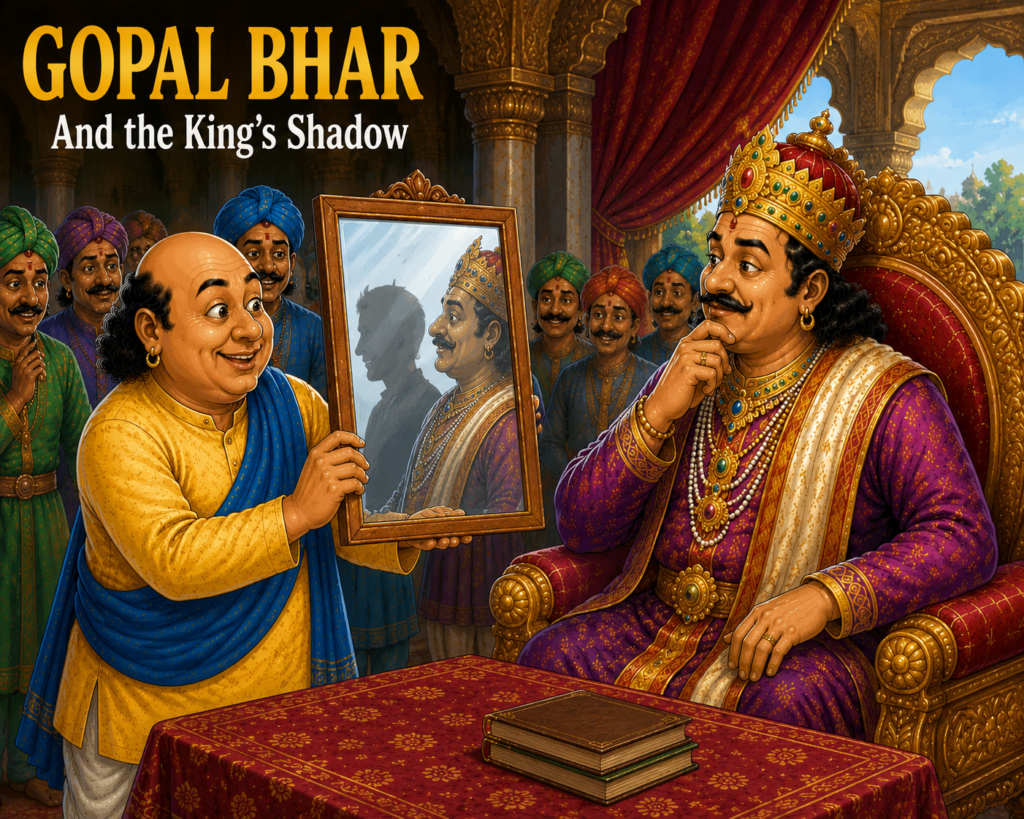
“Gopal, tomorrow morning I want you to bring my shadow to the royal court.”
The courtiers exchanged amused glances.
How could anyone possibly catch a shadow?
The following morning, the entire court gathered eagerly, waiting to see what Gopal would do.
Right on time, Gopal entered the court carrying a large mirror.
The king looked at him with curiosity.
“What is this for?”
Without saying a word, Gopal held the mirror before the king.
In the bright morning sunlight, the king’s reflection appeared clearly in the mirror, along with the outline of his shadow.
Gopal bowed respectfully.
“Your Majesty, a shadow cannot be separated from its owner. But it can certainly be shown.”
For a moment, the royal court was silent.
Then smiles spread across every face.
King Krishnachandra laughed with delight.
“Gopal,” he said, “once again you have accomplished what everyone believed to be impossible.”
Gopal smiled.
“Your Majesty, impossible problems are often solved not by strength, but by changing the way we think.”
The king praised Gopal’s remarkable ingenuity and rewarded him before the entire court.
Reflection
Creativity begins where ordinary thinking ends. When a problem seems impossible, the answer is often not to work harder—but to see it differently. Wisdom is the art of discovering possibilities where others see only obstacles.
Episode 21: Gopal Bhar and the Golden Seed
Setting the Scene
Greed makes people believe the unbelievable.
When extraordinary promises are wrapped in mystery, many accept them without asking for proof. In this classic tale, Gopal Bhar exposes a clever fraud with nothing more than logic, honesty, and a perfectly timed question.
Gopal Bhar and the Golden Seed
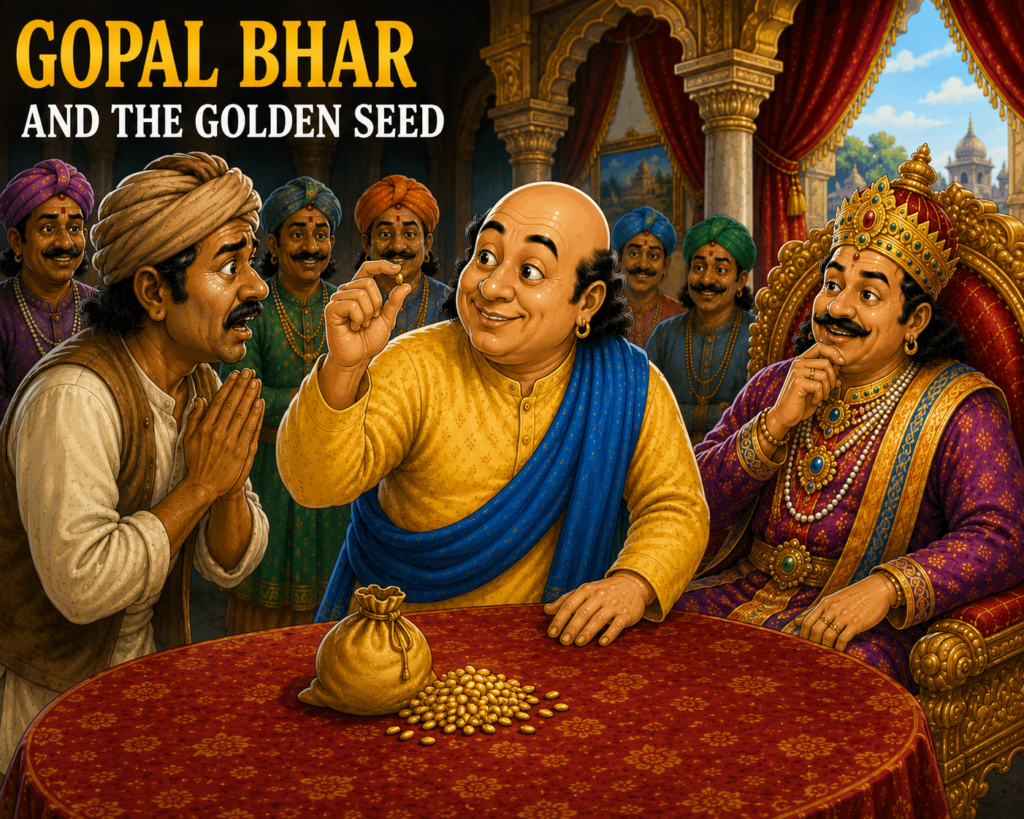
One day, a wandering trickster arrived at the court of King Krishnachandra carrying a small pouch.
With great confidence, he announced,
“Your Majesty, I possess a miraculous seed. Plant it, and it will grow into a tree that bears pure gold.”
A wave of curiosity swept through the royal court.
The king looked intrigued.
“Can you prove it?”
“Certainly,” replied the man. “But there is one condition.”
“And what is that?”
“The seed will grow only if it is planted by someone who has never told a single lie in their entire life.”
The court fell silent.
The king looked thoughtfully at the pouch before turning to Gopal Bhar.
“Gopal, perhaps you should plant it.”
Gopal examined the tiny seed and smiled.
“Your Majesty, I cannot. I am sure that at some point in my childhood I must have told a lie.”
The king laughed softly.
“Then I cannot plant it either.”
One by one, the courtiers were invited forward.
None dared claim a life completely free of lies.
At last, Gopal turned to the trickster.
“Then perhaps you should plant it yourself. Surely you have never spoken a lie.”
The man’s face turned pale.
He hesitated.
He stammered.
He had no answer.
The royal court erupted in laughter.
King Krishnachandra immediately realized that the entire scheme had been a deception.
The trickster bowed his head in shame.
Gopal smiled gently.
“Your Majesty, anyone who cannot prove their own honesty should not expect others to believe extraordinary claims.”
The king praised Gopal’s wisdom and ordered the trickster to leave the court.
Reflection
Extraordinary claims require extraordinary evidence. Wisdom begins with asking honest questions, while blind belief often opens the door to deception. Reason remains our strongest protection against false promises.
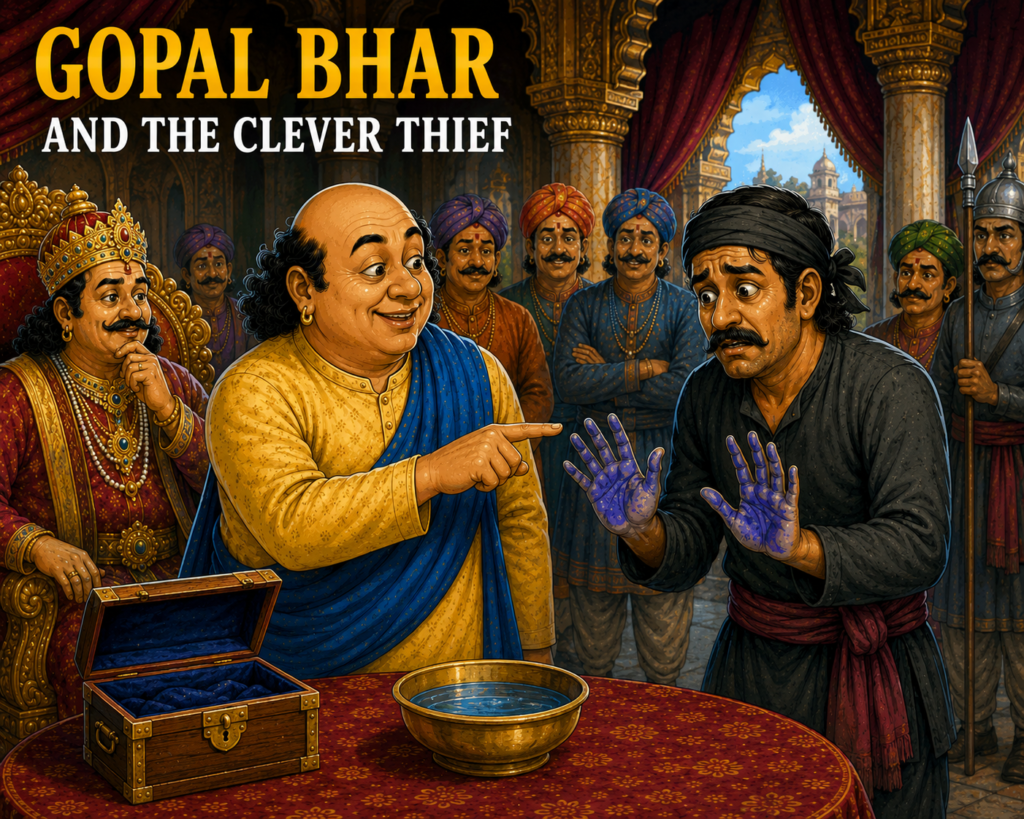
Episode 22: Gopal Bhar and the Clever Thief
Setting the Scene
No thief is clever enough to escape forever.
The more carefully a crime is planned, the more confidently the criminal believes they are beyond suspicion. But wisdom often succeeds where force fails. In this classic tale, Gopal Bhar catches a master thief not with weapons, but with intelligence.
Gopal Bhar and the Clever Thief
For several weeks, mysterious thefts had troubled the kingdom.
Valuable possessions disappeared from one house after another.
Yet the thief was so careful that he never left behind a single clue.
King Krishnachandra grew increasingly concerned.
Summoning Gopal Bhar, he asked,
“Gopal, can you find a way to catch this thief?”
“I shall certainly try, Your Majesty,” Gopal replied.
The next day, Gopal quietly spread a rumor throughout the kingdom.
“Tonight, a priceless diamond will be placed inside the royal treasury.”
The news was deliberately allowed to reach the ears of the thief.
That evening, Gopal scattered a fine, invisible powder across the entrance to the treasury.
The powder could not be seen in daylight, but it turned deep blue when it came into contact with water.
Late that night, exactly as Gopal had expected, the thief slipped into the treasury.
He searched every corner.
There was no diamond.
Disappointed, he escaped before dawn.
The following morning, the king gathered the palace guards, servants, and courtiers.
Gopal addressed them calmly.
“Everyone will now wash their hands.”
One by one, they dipped their hands into bowls of water.
Suddenly, one man’s hands turned a brilliant shade of blue.
His face went pale.
He began to tremble.
Gopal smiled.
“When you entered the treasury, the powder clung to your hands. Today, the truth has revealed itself.”
The thief could no longer deny his crime.
He confessed everything.
King Krishnachandra praised Gopal’s remarkable ingenuity.
“Where strength fails,” the king declared, “wisdom prevails.”
Reflection
A crime may remain hidden for a time, but truth has a remarkable way of revealing itself. Intelligence, patience, and careful planning are often stronger than force or fear.