A Chronological and Philosophical Review of the Vedas, Upanishads, and the Gita
THE DAWN OF VEDIC WISDOM
A Chronological and Philosophical Review of the Vedas, Upanishads, and the Gita
INTRODUCTION: THE CHRONOLOGY AND IMPACT OF THE VEDAS
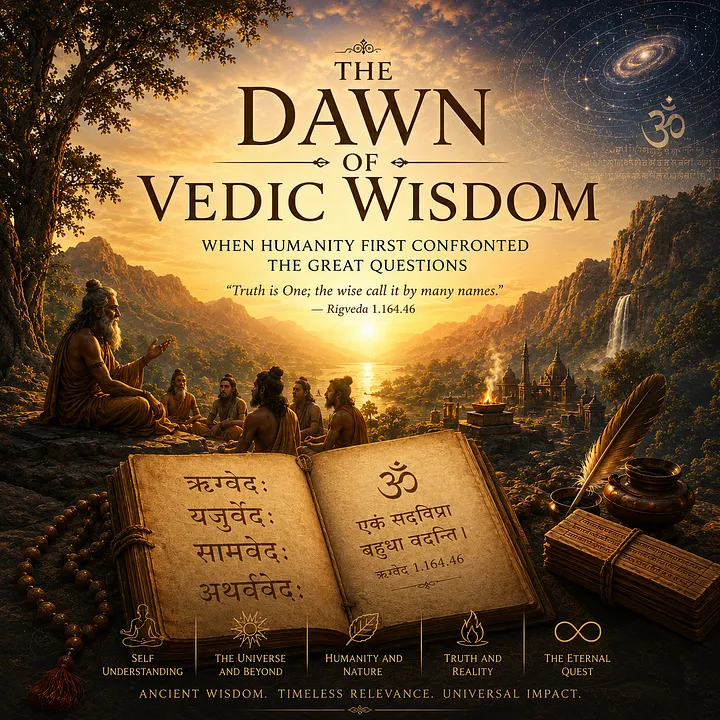
Determining the exact dawn of the four Vedas—the Rigveda, Samaveda, Yajurveda, and Atharvaveda—presents a profound challenge to the modern mind. Because these ancient texts are inherently metaphysical rather than historical, they do not record linear calendar years or temporal eras. Modern attempts to chart their timeline generally split into two fascinating paths: the Western academic approach, relying on philological layers and material culture, and the traditional Indian method, which looks at the internal astronomical maps recorded by the ancient seers themselves.
Part I: The Western Academic Horizon
1. Max Müller
Among Western scholars, Max Müller pioneered the first systematic effort to categorize the massive corpus of Vedic literature. He perceived a chronological evolution through four distinct layers: the Chhanda (poetic), Mantra (hymnal), Brahmana (ritual), and Sutra (aphoristic) periods. Working within these structured strata, he initially postulated a baseline around 1200 BCE, but with true scholarly humility, he famously admitted the limits of human dating:
“We cannot hope to fix a chronological date for the first dawn of Vedic literature… Whether the Vedic hymns were composed 1000, 1500, 2000, or 3000 years B.C., no power on earth will ever determine.” Reference: Max Müller, F. (1859). A History of Ancient Sanskrit Literature So Far as It Illustrates the Primitive Religion of the Brahmans. London: Williams and Norgate, p. 572.
2. A. A. Macdonell
Following this academic lineage, A. A. Macdonell viewed the Vedas not as a sudden creation, but as the organic fruit of a long, centuries-long historical process. He recognized that the shifting grammar and internal structures of the Rigvedic language required an extended timeline, refining the earlier rigid estimates:
“Vedic literature, rather than being a single work, represents a long process of development. We may safely assume that the earliest hymns of the Rigveda were not composed later than 1300 B.C., while the latest parts may date around 1000 B.C.” Reference: Macdonell, A. A. (1900). A History of Sanskrit Literature. New York: D. Appleton and Company, p. 12.
3. Moriz Winternitz
The Austrian indologist Moriz Winternitz strongly critiqued the narrow timelines of his predecessors, calling the 1200 BCE boundary unfounded and overly restrictive. Pointing to the vastness of the literature and its radical divergence from the older Indo-Iranian linguistic root, he envisioned a much broader horizon for its birth:
“We cannot introduce the Vedic literature into the history of the world with a fixed date of 1200 B.C. or 1500 B.C. The development of this great literature must have occupied centuries… We must position the beginning of the Veda nearer to 2500 or 2000 B.C.” Reference: Winternitz, M. (1927). A History of Indian Literature (Vol. I). Translated by Mrs. S. Ketkar. Calcutta: University of Calcutta, p. 310.
Part II: The Astronomical maps of Indian Scholarship
1. Bal Gangadhar Tilak
Bypassing subjective linguistic debates, Lokmanya Bal Gangadhar Tilak took a unique approach by mathematically analyzing the precise planetary configurations, stellar descriptions, and the positions of the vernal equinox frozen within the verses by the ancient seers:
“The astronomical evidence unmistakably points to a period when the vernal equinox was in the constellation of Orion, which means that the Vedic hymns were already in existence and being sung as far back as 4000 or 4500 B.C.” Reference: Tilak, B. G. (1893). The Orion, or Researches into the Antiquity of the Vedas. Bombay: Mrs. Radhabai Atmaram Sagoon, p. 220.
2. K. L. Daphtari
K. L. Daphtari similarly turned to empirical cosmic data to build his framework. By conducting meticulous mathematical tracking of documented planetary eclipses and specific cosmic conjunctions mentioned across various hymns, he established a firm, verifiable anchor for the core of the collection:
“The fine mathematical calculations of planetary movements and eclipses mentioned in the Vedic texts provide a stable basis to conclude that the core hymns of the Rig-Veda were systematically composed and organized around 2300 B.C.”
Chronology Conclusion
Beyond the debates over dates, global scholarship stands united on one profound truth: the Vedas are not a singular, static book, but a majestic compilation mirroring centuries of evolving human thought and cultural depth. Ultimately, they offer a timeless window into the origins of human language and universal introspection, serving as a foundational pillar of cultural sovereignty and spiritual identity.
CHAPTER 1: THE RIGVEDA
Introduction
The Rigveda is the oldest living scripture in human history and the foundational cornerstone of Sanatan Dharma. The word Rik signifies praise, illumination, or a sacred metric verse. Comprising 1,028 hymns (Suktas) divided into 10 books (Mandalas), it stands as a timeless monument to humanity’s first profound inquiry into cosmic order, natural forces, and the nature of consciousness.
Core Teachings
A. The Absolute Oneness of Reality
Sanskrit (Roman Script): Ekam Sat Vipra Bahudha Vadanti; Agnim Yamam Matarishvanam Ahuh. (1.164.46)
English Translation: “Truth is One, though the wise call It by many names; they call It Agni, Yama, and Matarishvan.” — (Adapted from Abinash Chandra Bose)
Philosophical Significance: This verse lays the foundation for a deeply beautiful, inclusive worldview. It asserts that while the ultimate reality or divine essence is singular, the human vocabulary, cultural context, and perception of it are naturally varied. It presents a sovereign framework where different paths and names are respected as valid expressions of the same central Truth.
B. The Quest for Mental Illumination (The Gayatri Mantra)
Sanskrit (Roman Script): Om Tat Savitur Varenyam, Bhargo Devasya Dheemahi, Dhiyo Yo Nah Prachodayat. (3.62.10)
English Translation: “We meditate upon the glorious splendor of that Divine Vivifier; may He illuminate and inspire our intellects.” — (Adapted from Sri Aurobindo / Wendy Doniger)
Philosophical Significance: Positioned as a central pillar of Vedic meditation, this hymn completely bypasses requests for transient material wealth or external power. Instead, it targets the refinement and awakening of the human intellect (Dhi), recognizing a clear, illuminated consciousness as the highest human asset.
C. The Anthem of Human Unity (The Sangathan Sukta)
Sanskrit (Roman Script): Samgachhadhvam Samvadadhvam, Sam Vo Manamsi Janatam. (10.191.2)
English Translation: “Walk together, speak together, and let your minds be united in thought and understanding.” — (Adapted from R.L. Kashyap / SAKSI Trust)
Philosophical Significance: As the beautiful concluding command of the Rigveda, this hymn is a timeless manifesto for harmony and collective responsibility. It underscores that true progress relies on open dialogue, shared intent, and empathetic cooperation, establishing a vision of peace rooted in mutual understanding.
D. The Hymn of Creation (The Nasadiya Sukta)
Sanskrit (Roman Script): Na Asad Aaseet No Sad Aaseet Tadaneem, Na Aaseet Rajo No Vyoma Paro Yat. (10.129.1)
English Translation: “There was neither non-existence nor existence then; there was neither the realm of space nor the sky which is beyond. What stirred? Where? In whose protection?” — (Translated by Wendy Doniger, Penguin Classics)
Philosophical Significance: Reaching the absolute peak of existential inquiry, this hymn approaches the mystery of creation with breathtaking honesty. By postulating that the origin preceded the dual concepts of “existence” and “non-existence,” it celebrates a profound, meditative skepticism that honors the inquiring human mind over dogmatic assertions.
E. The Rhythm of Cosmos (Rita)
Sanskrit (Roman Script): Ritena Ritampihitam Dhruvam Sadavasi. (5.62.1)
English Translation: “By Eternal Law, the Cosmic Order is sustained, unchanging and absolute in its truth.” — (Academic Translation)
Philosophical Significance: This introduced the ancient concept of Rita—the immutable moral rhythm and natural order that governs everything from the path of the stars to the conduct of human life. It reveals a worldview where nature is not random or chaotic, but sustained by an inherent, intelligent principle of balance.
CHAPTER 2: THE YAJURVEDA
Introduction
The word Yajush signifies sacrificial prayers, dedicated actions, or acts of deep reverence. The Yajurveda serves as a practical, actionable guide, showing how to transform abstract spiritual thoughts into purposeful rituals and dynamic life-actions. It is historically divided into two major streams: the Shukla (White) Yajurveda and the Krishna (Black) Yajurveda.
Core Teachings
A. The Harmony of Nature (The Shanti Mantra)
Sanskrit (Roman): Om Dyauh Shantir-Antariksham Shantih, Prithivi Shantir-Aapah Shantir-Oshadhayah Shantih. Vanaspatayah Shantir-Vishve Devah Shantir-Brahma Shantih, Sarvam Shantih, Shantireva Shantih, Sa Ma Shantiredhi. Om Shantih, Shantih, Shantih. (Shukla Yajurveda – 36.17)
English Translation: “May there be peace in heaven, peace in the atmosphere, peace on earth. May the waters, the medicinal herbs, and the majestic trees be peaceful. May all divine forces bring peace, may the Supreme Reality be peace, and may peace prevail everywhere. May that absolute peace belong to me.” — (Adapted from R.T.H. Griffith / SAKSI Trust)
Philosophical Significance: This invocation weaves a deep environmental consciousness, viewing inner human peace as a direct mirror of ecological balance. It teaches that humanity cannot thrive in a broken world; any injury inflicted upon the outer elements naturally fractures the internal psychological sanctuary of humankind.
B. The Invocation for Absolute Fearlessness
Sanskrit (Roman): Abhayam Mitrad-Abhayam-Amitrad, Abhayam Jnatad-Abhayam Parokshat. Abhayam Naktam-Abhayam Diva, Sarva Asha Mama Mitram Bhavantu. (Yajurveda / Atharvaveda)
English Translation: “May I be free from fear of friends and free from fear of foes. May I be free from fear of what is known and what lies beyond the unknown. May I be fearless by night and fearless by day, and may all directions become my friend.” — (Adapted from Abinash Chandra Bose)
Philosophical Significance: Fearlessness (Abhayam) is celebrated here as the baseline for all real spiritual growth. This profound prayer aims to conquer anxiety at its very source—dissolving the dread of the unknown, the fear of conflict, and the hostility of space, beautifully re-imagining the universe as a welcoming, friendly home.
C. The Purification of Sensory Consumption
Sanskrit (Roman): Bhadram Karnebhih Shrinuyama Deva, Bhadram Pashyema-Akshabhir-Yajatraah. (Yajurveda – 25.21)
English Translation: “O Divine Powers, may we hear with our ears what is noble and auspicious. O worshipful ones, may we see with our eyes what is beautiful and pure.” — (Adapted from SAKSI Trust)
Philosophical Significance: This verse establishes a direct link between sensory choices and character building. It asserts that our consciousness is continuously shaped by what we choose to absorb. By filtering our consumption to focus on that which is noble, creative, and pure, we safeguard our inner mental peace from external chaos.
D. The Intent of the Soul (Shiva-Sankalpa)
Sanskrit (Roman): Tanme Manah Shiva Sankalpamastu. (Shukla Yajurveda – 34.1)
English Translation: “May my mind be filled with noble, beautiful, and auspicious resolves.” — (Academic Translation)
Philosophical Significance: The Shiva-Sankalpa Sukta recognizes that every human creation or action begins as a silent thought. It teaches that true mastery of life starts by anchoring our internal desires and will power to righteousness, ensuring our internal blueprint is pure before we act in the world.
CHAPTER 3: THE SAMAVEDA
Introduction
The word Sama means a musical chant, a structured melody, or a song of sweet harmony. The Samaveda is the lyrical rendition of the Rigvedic verses, woven into precise musical scores to be sung during sacred rituals. It stands as the deep historical source of Indian classical music, aesthetics, and the timeless science of spiritual acoustics (Nada Brahma).
Core Teachings
A. The Divine as the Closest Friend
Sanskrit (Roman): Agne Tvam No Antama Uta Trata Shivo Bhavo Varoothyah. (1.1.1)
English Translation: “O Divine Light, be closest to us; be our savior, our benevolent guide, and our ultimate refuge.” — (Adapted from R.T.H. Griffith / SAKSI Trust)
Philosophical Significance: This teaching strips away the terrifying image of a distant, wrathful deity. It frames the ultimate consciousness as an intimate companion, an accessible guide, and a protector residing right within the human heart, trading fear-driven dogma for an affectionate spiritual bond.
B. The Alchemy of Mind and Bliss
Sanskrit (Roman): Punati Te Parisrutam Somam Suryasya Duhita, Varena Shashvata Tana.
English Translation: “May the daughter of the Sun (faith and devotion) purify the flowing Soma (mind and consciousness) within us, turning it into a source of eternal bliss.” — (Adapted from Wendy Doniger / Indian Heritage Texts)
Philosophical Significance: Moving beneath the surface, this verse uses the ancient metaphor of Soma to trace human psychology. It teaches that when raw thoughts and volatile emotions are filtered through steady devotion and clear focus, they are refined into a state of enduring joy and unshakeable resilience.
C. Harmonizing with the Universal Sacrifice
Sanskrit (Roman): Agnim Dutam Vrinimahay Hotaram Vishvavedasam, Asya Yagyasya Sukratum.
English Translation: “We choose the Divine Light as our messenger, who is the repository of all wisdom and the grand director of this universal sacrifice (the cosmic order).” — (Adapted from SAKSI Trust)
Philosophical Significance: This hymn perceives the entire universe as a continuous, collaborative sacrifice (Yajnya), where every element gives to sustain the other. It inspires human beings to align their daily life and work with this vast, natural rhythm of interconnectedness.
D. The Primeval Resonance (Udgeetha)
Sanskrit (Roman): Om-ityetad-aksharam-udgeetham-upasita. (Samaveda / Chandogya)
English Translation: “Let a man meditate on the syllable OM, which is the foundational note of the universe.” — (Academic Translation)
Philosophical Significance: This teaching identifies the syllable OM as the primordial vibration that echoes beneath all physical forms. Meditating on this sound is presented as a direct practice to still mental chatter and tune individual awareness back into the resting rhythm of the cosmos.
CHAPTER 4: THE ATHARVAVEDA
Introduction
The word Atharvan honors the ancient lineage of seers who safeguarded the wisdom of everyday life. Unlike the abstract theology of the other three Vedas, the Atharvaveda addresses the practical realities of human society—weaving insights on physical healing, sociology, statecraft, and the foundational heritage of Ayurveda (the science of balanced life).
Core Teachings
A. The Kinship with Mother Earth (The Bhumi Sukta)
Sanskrit (Roman): Mata Bhumih Putro Aham Prithivyah. (12.1.12)
English Translation: “The Earth is my mother, and I am a child of this Earth.” — (Adapted from Abinash Chandra Bose)
Philosophical Significance: This iconic line radically opposes any model of exploiting or conquering nature. Instead, it places humanity as an inseparable offspring of the biosphere, declaring a deep, familial duty to protect, respect, and nurture the planet as a living, breathing parent.
B. The Celebration of a Purposeful Life
Sanskrit (Roman): Pashyema Sharadah Shatam, Jeevema Sharadah Shatam. (19.67.1)
English Translation: “May we see for a hundred autumns, may we live for a hundred autumns, and may we continue to learn and grow for a hundred autumns.” — (Adapted from SAKSI Trust)
Philosophical Significance: Vedic philosophy completely rejects world-negating despair. A long life of a hundred autumns is framed as a joyful opportunity for intellectual expansion, service to the collective, and continuous inner awakening.
C. The Deconstruction of Hatred
Sanskrit (Roman): Sahridayam Samanasyam-Avidvesham Krinomi Vah, Anyo Anyam-Abhi Haryata Vatsam Jatam-Iva-Aghnya. (3.30.1)
English Translation: “I make you united in heart, united in mind, and free from hatred. Love one another as a mother cow loves her newborn calf.” — (Adapted from Ralph T.H. Griffith / SAKSI Trust)
Philosophical Significance: This verse sets a powerful social ideal for harmony. By utilizing the intensely raw, protective metaphor of a mother cow and her newborn calf, the text demands that empathy and natural affection serve as the baseline for all human connection, dissolving the barriers of tribal malice.
D. The Ethics of Shared Resource
Sanskrit (Roman): Samani Prapa Saha Vonnabhagah. (3.30.6)
English Translation: “Shared be your water-store, and common be your food-share; I bind you together with a common bond.” — (Academic Translation)
Philosophical Significance: This verse focuses directly on social and material equity. It marks a foundational rule for communal survival: that life-sustaining necessities like clean water and nourishment belong to the whole, framing shared resources as the absolute baseline for a stable society.
HISTORICAL CONTEXT: VEDIC LIFE AND THE SEERS (RISHIS)
To truly feel the power of these philosophical breakthroughs, they must be viewed within the shifting socio-political landscapes of the Early Vedic Period (1500–1000 BCE) and the Later Vedic Period (1000–600 BCE).
1. The Political Landscape
Early Vedic Era: Governance was fluid, decentralized, and rooted in the tribe (Jana). The chief (Rajan) held non-absolute authority and acted as a guardian overseen by two vital democratic institutions: the Sabha (a wise council of elders) and the Samiti (a popular assembly of the common citizens).
Later Vedic Era: As the small clans expanded into large regional kingdoms (Janapadas), monarchy grew centralized. Grand rituals like Rajasuya and Ashvamedha were deployed to declare imperial rule, which gradually weakened the democratic assemblies and concentrated power in the throne.
Primary Historical Sources: Basham, A. L. The Wonder That Was India (Vol. 1); Majumdar, R. C. The Vedic Age (Vol. 1).
2. Social Dynamics and Gender Equity
Early Vedic Era: Society was deeply dynamic and egalitarian. The Varna classification was flexible, determined entirely by individual talent, inclination, and occupation (Karma) rather than birthright. Women enjoyed equal stature: practices like child marriage or forced immolation (Sati) were completely non-existent. Women had full access to high education, received the sacred thread (Upanayana), and sat as active debaters within the political Sabha.
Later Vedic Era: The transition into a settled, agrarian economy brought institutional rigidity. Social lines hardened into a hereditary, caste system. While the presence of women remained spiritually mandatory for key rituals, their secular freedom, political rights, and access to education faced heavy restrictions.
Primary Historical Sources: Thapar, Romila. Early India: From the Origins to AD 1300; Altekar, A. S. The Position of Women in Hindu Civilization.
3. The Lineage and Identity of the Rishis
The Vedic Rishis were not institutional priests or traditional administrators; they were Mantradrashta—the “seers of truth.” Through the stillness of intense meditation, they intuitively perceived the core laws of reality and translated those insights into the metric songs of the Vedas.
The Collective Corpus: The Rigvedic canon preserves the visions of over 400 unique seers. Mandalas 2 through 7 are celebrated as the Vamsha Mandalas (Family Books), each guarded by a distinct lineage of seers.
The Female Seers (Brahmavadinis): Women who chose a life of single-minded focus to pursue metaphysical philosophy and truth were called Brahmavadinis. The Rigveda explicitly honors 27 prominent female Rishis along with the brilliant hymns they envisioned.
Primary Historical Sources: Kane, P. V. History of Dharmasastra (Vol. II).
4. Illustrious Seers and Their Living Legacy
Eminent Male Seers
Rishi Vishvamitra: The great seer of the 3rd Mandala; his deep contemplation revealed the Gayatri Mantra (Rigveda 3.62.10), prioritizing clarity of intellect above all else.
Rishi Vashistha: The chief seer of the 7th Mandala, whose beautiful hymns weave deep spiritual surrender with the principles of Rajadharma (ethical statecraft).
Rishi Bharadvaja: The seer of the 6th Mandala; a master of mechanical and analytical lore, celebrated as an early source of Ayurveda.
Rishi Dirghatamas: A blind seer of the 1st Mandala, whose inner eye captured the timeless অদ্বৈত statement: Ekam Sat Vipra Bahudha Vadanti (Rigveda 1.164.46).
The Saptarshi Lineage: Sage Gritsamada (2nd Mandala), Sage Vamadeva (4th Mandala), and Sage Atri (5th Mandala).
Eminent Female Seers (Brahmavadinis)
Vak Ambhrini: The brilliant seer of the Devi Sukta (Rigveda 10.125). In a moment of absolute non-dualistic realization, she speaks not to a power, but as the very cosmic force that creates and breathes through all things.
Lopamudra: A philosopher-princess and seer of the 1st Mandala (Rigveda 1.179); she demonstrated that the highest peaks of spiritual clarity can be climbed while fully living the domestic and secular path.
Surya Savitri: The seer of the Vivaha Sukta (Rigveda 10.85); her verses lay down the foundational promises and beautiful symbols still chanted in weddings today.
Ghosha: A female seer of the 10th Mandala (Rigveda 10.39 & 10.40) who, through her insights into healing, composed beautiful hymns dedicated to the cosmic deities of medicine.
CHAPTER 5: THE UPANISHADS
Introduction
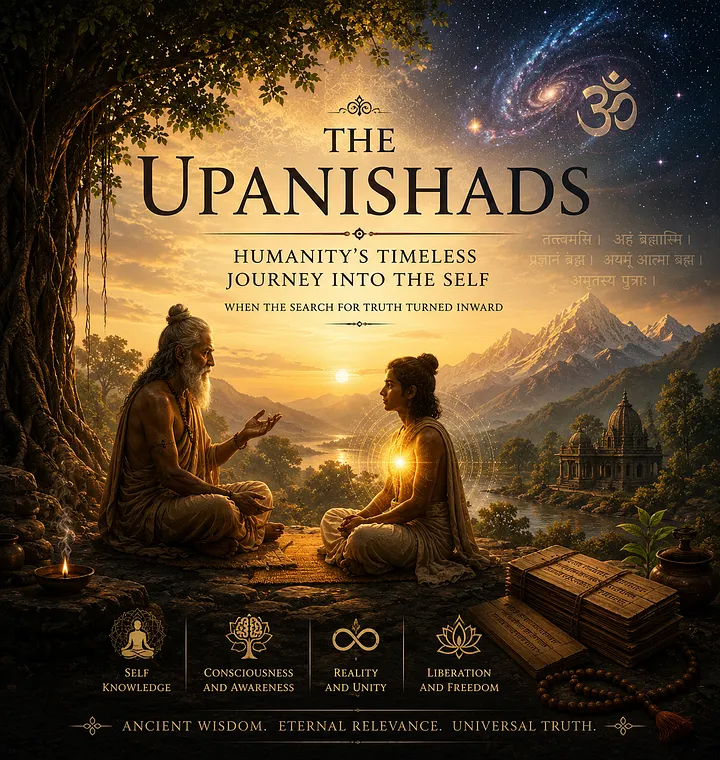
The word Upanishad evokes the picture of “sitting down closely near a master.” Representing the crown of the Vedic corpus—known structurally as Vedanta (the fulfillment of the Vedas)—these texts record an internal revolution. They turn the human gaze away from external physical rituals toward the landscape of pure metaphysics and contemplative psychology, declaring a breathtaking truth: the universal, infinite ground of existence (Brahman) is one with the immortal witness within you (Atman).
Part I: Academic Datings
1. Max Müller
“The Upanishads… are older than Buddha. They represent a state of thought which led up to Buddhism, and they must be assigned to a period prior to the sixth century B.C.” Reference: A History of Ancient Sanskrit Literature (1859), p. 320.
2. Paul Deussen
“We may distinguish four periods in the development of the Upanishad literature… The oldest, the prose Upanishads (Brihadaranyaka and Chandogya), can hardly be dated later than 800-600 B.C.” Reference: The Philosophy of the Upanishads (1906), Chapter I, p. 23.
3. A. A. Macdonell
“The earliest of them can hardly be dated later than 600 B.C., since their philosophy represents a phase of thought which is presupposed by Buddhism.” Reference: A History of Sanskrit Literature (1900), Chapter VIII, p. 226.
4. Dr. Sarvepalli Radhakrishnan
“The earliest Upanishads belong to the eighth and seventh centuries B.C. They represent the concluding portion of the Veda, and are chronologically prior to Buddha and Mahavira.” Reference: Indian Philosophy (1923), Volume 1, Chapter IV.
5. Surendranath Dasgupta
“The earliest Upanishads were compiled by about 500 B.C. or 600 B.C., just before the rise of Buddhism. But some of the material may be much older, stretching back to 1000 B.C.” Reference: A History of Indian Philosophy (1922), Volume 1, p. 39.
6. Bal Gangadhar Tilak
“The Vedic hymns and the Brahmanas, including the older Upanishads, must be assigned to a period much earlier than 1000 B.C., probably between 2500 B.C. and 1600 B.C., based on the astronomical positions of the constellations mentioned.” Reference: The Orion, or, Researches into the Antiquity of the Vedas (1893), Chapter VII.
Part II: Core Teachings
1. The Call of the Internal Ascent
Sanskrit (Roman): Asato Ma Sad Gamaya, Tamaso Ma Jyotir Gamaya, Mrityor Ma Amritam Gamaya. (Brihadaranyaka Upanishad – 1.3.28)
English Translation: “Lead me from the unreal to the Real. Lead me from darkness to Light. Lead me from death to Immortality.” — (Translated by Swami Prabhavananda / Christopher Isherwood)
Philosophical Significance: This is the ultimate compass of human aspiration. It recognizes that unawakened life is easily caught in transient mirrors (the unreal), mental fog (darkness), and the terror of decay (death), mapping out a deep reorientation toward that which is true, luminous, and deathless.
2. The Victory of Truth
Sanskrit (Roman): Satyamev Jayate Nanritam, Satyena Pantha Vitato Devayanah. (Mundaka Upanishad – 3.1.6)
English Translation: “Truth alone triumphs, not untruth. By Truth is laid out the divine path that leads to the ultimate.” — (Adapted from Juan Mascaró / Penguin Classics)
Philosophical Significance: Adopted as the foundational motto of modern India, this verse announces a deep moral law: illusion and manipulation have no permanent foundation. Only that which stands aligned with reality can endure, serving as the essential bedrock for human ethics.
3. The Great Equation
Sanskrit (Roman): Tat Tvam Asi. (Chandogya Upanishad – 6.8.7)
English Translation: “Thou Art That.” — (Adapted from Max Müller)
Philosophical Significance: As one of the core Mahavakyas (Grand Statements) of Vedanta, this verse bridges the deep split between the individual and the cosmos. It tells the seeker that the vast, creative intelligence of the universe is not a distant sky-god to be feared, but is the exact unconditioned Awareness resting within themselves.
4. The Delight of Renunciation
Sanskrit (Roman): Isha Vasyam Idam Sarvam Yat Kim Cha Jagatyam Jagat, Tena Tyaktena Bhunjitha Ma Gridhah Kasya Svid Dhanam. (Isha Upanishad – 1)
English Translation: “All this—whatever moves in this changing world—is enveloped by the Divine. Therefore, find your enjoyment in renunciation; do not covet what belongs to others.” — (Adapted from Sri Aurobindo / Swami Nikhilananda)
Philosophical Significance: This teaching offers a profound antidote to hyper-consumerism. It reveals that because everything is part of a singular cosmic whole, we find true joy not by hoarding or conquering, but through a posture of detached appreciation (Tena Tyaktena Bhunjitha), freeing ourselves from the anxiety of greed.
5. The Paradox of Wholeness
Sanskrit (Roman): Om Purnamadah Purnamidam Purnat Purnamudachyate, Purnasya Purnamadaya Purnamevavashishyate. (Brihadaranyaka & Isha Upanishad)
English Translation: “That is whole, this is whole; from wholeness, wholeness comes forth. If you take away wholeness from wholeness, only wholeness remains.” — (Adapted from Eknath Easwaran)
Philosophical Significance: This verse captures the infinite nature of reality. It states that existence is unbroken; when the phenomenal universe projects out from the absolute source, the source remains undiminished. No matter how many forms emerge, the underlying integrity of existence remains an absolute unity.
6. The Landscape of Absolute Oneness
Sanskrit (Roman): Yastu Sarvani Bhutani Atmanyeva-Anupashyati, Sarvabhuteshu Chatmanam Tato Na Vijugupsate. (Isha Upanishad – 6)
English Translation: “He who sees all beings in his own Self, and his own Self in all beings, can never look down upon or hate anyone.” — (Adapted from SAKSI Trust)
Philosophical Significance: This is the absolute apex of pure empathy. The text states that hatred, malice, and prejudice are simply illusions born of a sense of separation. Once you witness your own core consciousness reflecting within all living things, hostility naturally dissolves into compassion.
7. The Children of Bliss
Sanskrit (Roman): Shrinvantu Vishve Amritasya Putrah, Aa Ye Dhamani Divyani Tasthuh. (Shvetashvatara Upanishad – 2.5)
English Translation: “Hear, O children of immortal bliss, even you who dwell in higher divine realms!” — (Famously cited by Swami Vivekananda at the 1893 Chicago Parliament of Religions)
Philosophical Significance: This verse beautifully reclaims human dignity. Refusing to view humanity as inherently broken or born in sin, it addresses all individuals as “Children of Immortal Bliss” (Amritasya Putrah), calling them back to their birthright of unconditioned beauty.
8. The Deathless Witness
Sanskrit (Roman): Na Jayate Mriyate Va Vipashchin-Nayam Kutashchin-Na Babhuva Kashchit, Ajo Nityah Shashvato-Ayam Purano Na Hanyate Hanyamane Sharire. (Katha Upanishad – 1.2.18)
English Translation: “The knowing Self is never born, nor does it die; it sprang from nothing, and nothing sprang from it. It is unborn, eternal, everlasting, and ancient; it is not slain when the body is slain.” — (Adapted from Swami Prabhavananda)
Philosophical Significance: This teaching directly meets the deepest human dread—the death of the physical frame. It distinguishes between the physical container (the body), which changes and passes, and the underlying consciousness (the Atman), which remains untouched by time, offering absolute existential peace.
9. The Sharp Edge of Awakening
Sanskrit (Roman): Uttisthata Jagrata Prapya Varan-Nibodhata, Kshurasya Dhara Nishita Duratyaya Durgam Pathastat Kavayo Vadanti. (Katha Upanishad – 1.3.14)
English Translation: “Arise! Awake! Approach the great ones and learn the Truth. Narrow is the path and difficult to tread, sharp as the razor’s edge—so say the wise.” — (Famous inspiration for W. Somerset Maugham’s novel ‘The Razor’s Edge’)
Philosophical Significance: This urgent call reminds us that waking up is not a passive event. The path requires continuous mindfulness, an active heart, and deep mental focus—metaphorically described as walking upon the sharp, subtle edge of a razor.
10. The Cosmic Identity
Sanskrit (Roman): Aham Brahmasmi. (Brihadaranyaka Upanishad – 1.4.10)
English Translation: “I Am Brahman.” — (Adapted from Academic Translations)
Philosophical Significance: A majestic Mahavakya, this internal realization completely shatters all small, localized self-doubts. It is the moment where the seeker ceases to look outward into the sky for a savior and realizes that their own silent awareness is the very fabric of existence.
11. The Substance of Reality
Sanskrit (Roman): Prajnanam Brahma. (Aitareya Upanishad – 3.1.3)
English Translation: “Consciousness is Brahman.” — (Adapted from SAKSI Trust)
Philosophical Significance: This statement clarifies the ultimate nature of the universe. It states that the ground of reality is not cold, dead matter, but pure, unconditioned Awareness (Prajnanam), from which every name and form dances into existence.
12. The Global Family
Sanskrit (Roman): Ayam Nijah Paro Veti Ganana Laghuchetasam, Udaracharitanam Tu Vasudhaiva Kutumbakam. (Maha Upanishad – 6.71)
English Translation: “This is my own relative, and that is a stranger”—such is the calculation of narrow-minded people. For those of noble character, the entire world is but one family.” — (Global Peace Anthem)
Philosophical Significance: This teaching completely bypasses modern borders and social divides. It labels the psychological separation between “us” and “them” as a symptom of a restricted intellect, declaring that a mature mind embraces the entire planet as a single, collective home.
13. The Geometry of Joy
Sanskrit (Roman): Yo Vai Bhuma Tat Sukham Nalpe Sukhamasti. (Chandogya Upanishad – 7.23.1)
English Translation: “Infinite joy lies only in the Infinite (Bhuma); there is no enduring happiness in the finite or limited things.” — (Adapted from Eknath Easwaran)ৎ
Philosophical Significance: This text maps out human happiness. It shows that collecting finite, material things can only bring brief comfort, because the human heart possesses an infinite thirst that can only be filled by expanding into the wide, limitless ocean of unconditioned consciousness.
Part III: Global Historical Testimonials on the Upanishads
1. The Global Resonance
Erwin Schrödinger:
“Quantum mechanics suffers from the problem of observer and observed being entangled. The grandest and oldest solution to this dualism is found in the Upanishads’ Tat Tvam Asi. Consciousness is a singular of which the plural is unknown; all of us are but aspects of one single consciousness.” Source: Schrödinger, Erwin. What is Life? with Mind and Matter (1944) & My View of the World (1961), Cambridge University Press.ৎ
Arthur Schopenhauer:
“From every page of the Upanishads deep, original and sublime thoughts arise… It is the most rewarding and elevating reading which is possible in the world; it has been the solace of my life and will be the solace of my death.” Source: Schopenhauer, Arthur. Parerga and Paralipomena (1851), Volume II, Section 184.
Friedrich Max Müller:
“I do not hesitate to say that I owe all that is best in my own intellectual and spiritual life to the study of these grand texts… They are to me like the light of the morning, like the pure air of the mountains – so simple, so true, if once understood.” Source: Müller, F. Max. The Upanishads (Sacred Books of the East, Vol. I, 1879) Preface.ৎ
Kakuzo Okakura:
“Asia is one. The same light of Advaita Vedanta and Upanishadic wisdom that shone across the Himalayas vibrates through the Shinto and Zen paths of Japan. The Upanishads teach that all life is one, and this oneness is the real strength of Asia.” Source: Okakura, Kakuzo. The Ideals of the East with Special Reference to the Art of Japan (John Murray, London, 1903).
Walt Whitman:
“I am the track of the feet of the rishis along the Ganges… Leaves of Grass is only the Upanishads in modern clothes.” Source: Whitman, Walt. Leaves of Grass (1855) – ‘Song of Myself’ & Thomas Donaldson’s Walt Whitman the Man (1896).
Leo Tolstoy:
“I have read the Upanishads and the Gita, and they have greatly influenced me… The concept of the soul as one with the universe helps man to eliminate the ego and realize the true meaning of existence.” Source: Tolstoy, Leo. A Letter to a Hindu (1908) and personal diaries (1909).
Romain Rolland:
“If there is one place on the face of earth where all the dreams of living men have found a home from the very earliest days when man began the dream of existence, it is India… The Vedas offer a total spiritual liberation through the great minds of Ramakrishna and Vivekananda.” Source: Rolland, Romain. La Vie de Ramakrishna (1929) and La Vie de Vivekananda (1930).
Hu Shih:
“India conquered and dominated China culturally for twenty centuries without ever having to send a single soldier across her border. She did it through the timeless truths of her Vedas, Upanishads and Buddhist philosophy.” Source: Hu Shih. “The Indianization of China” (Harvard Tercentenary Publications, Harvard University Press, 1937).
2. The Native Vision
Rabindranath Tagore:
“The rishis of the Upanishads did not worship any material object; they realized the Supreme Truth within the human soul, which pervades the entire universe. This ancient message of India will show the path of liberation to the world.” Source: Tagore, Rabindranath. Sadhana: The Realisation of Life (1913), Chapter 1, Macmillan Publishers.
Mahatma Gandhi:
“If all the Upanishads and all the other scriptures happened all of a sudden to be reduced to ashes, and if only the first verse in the Ishopanishad were left intact in the memory of Hindus, Hinduism would live forever.” Source: Gandhi, M. K. Speech at Kottayam, March 1937; Published in Harijan, 1937.
Swami Vivekananda:
“This is the great fact: strength is what the Upanishads speak to me from every page… Ay, this is the one great thing to remember, it is the only literature in the world where you find the word ‘Abhihi’, ‘fearless’, used again and again.” Source: Vivekananda, Swami. Lectures from Colombo to Almora (1897).
Raja Ram Mohan Roy:ৎ
“My constant reflections on the Upanishads convinced me that the unity of God is the sole matter taught in those sacred writings… and to worship Him in spirit is the only true form of devotion.” Source: Roy, Raja Rammohun. Introduction to the translation of The Kena Upanishad (1816).
Dr. Amartya Sen:
“The Vedas may be full of hymns and religious invocations, but they also tell stories, speculate about the world and ask difficult questions. A basic doubt concerns the very creation of the world… These doubts from the second millennium BCE would recur again and again in India’s long argumentative history.” Source: Sen, Amartya. The Argumentative Indian (2005), Picador.
Dr. B. R. Ambedkar:
“The Upanishads were a warfare against the Vedas… The Upanishads declared war on the Vedic Brahmins and their ritualism. But later, the Brahmins made the Upanishads subordinate to the Vedas to save their own authority.” Source: Ambedkar, B. R. Dr. Babasaheb Ambedkar: Writings and Speeches, Volume 4, Riddle No. 8.
Professor Romila Thapar:
“The Vedic period and the subsequent era of the Upanishads were not static; they were marked by intense intellectual debates between different philosophical schools, which shaped the multi-layered texture of early Indian history.” Source: Thapar, Romila. The Penguin History of Early India (2002), University of California Press>
Part IV: The Echo across Intellectual History
The Scientific Consciousness
Nikola Tesla: The foundational ideas of the Vedas found a deep, creative resonance in the mind of Nikola Tesla, the brilliant pioneer of electrical science. Following his historic dialogues with Swami Vivekananda in 1896, Tesla discovered that the cosmic dance of matter and energy he was tracking in his lab had been conceptually mapped out by the ancient seers millennia ago. Deeply moved by this structural clarity, Tesla integrated the Vedic concepts of Akasha (space/ether) and Prana (vital energy) directly into his scientific descriptions to explain the primary substance that fills all space and births creation in never-ending cycles.
Niels Bohr and Werner Heisenberg: The foundational fathers of quantum physics looked into the non-dual insights of Vedanta to process the paradoxical nature of the subatomic field, observing that the entanglement between observer and observed had been intuitively realized by the ancient sages.
Albert Einstein: Einstein held a deep appreciation for the cosmic religious feeling and unity that pulses through Indian thought. His revolutionary equations on the relativity of space-time echo the ancient understanding of Maya (the relative web of reality) and the unchanging Truth beneath it.
The Struggle for Dignity
Martin Luther King Jr.: The legendary leader of the American Civil Rights movement drew immense strength from the concept of Ahimsa (non-violence) in the Gita, which reached him through the legacy of Mahatma Gandhi, transforming love into a powerful social shield against systemic injustice.
Nelson Mandela and Desmond Tutu: The anti-apartheid icons of South Africa often reflected that the Vedic teaching of honoring the divine spark within all life forms offers a universal pillar for human dignity. This spiritual oneness mirrored their native African wisdom of Ubuntu (“I am because we are”), lighting their long journey toward a humane society.
The Literary Landscape
Helen Keller: Overcoming the silence of deaf-blindness, Helen Keller found a beautiful spiritual refuge in the Vedantic insights shared by Swami Vivekananda. Within her physical silence, the Upanishadic journey served as an anchor for her rich inner life and prose.
The Poets of Latin America: While Octavio Paz, Jorge Luis Borges, and Gabriela Mistral explored the metaphysics of Advaita (non-duality) directly, the great Nobel laureate Pablo Neruda captured the cosmic, cyclical rhythms of the East through the lyrical lens of Tagore’s Gitanjali, leaving an indelible mark on his poetic spirit.
CHAPTER 6: THE SHRIMAD BHAGAVAD GITA
Introduction
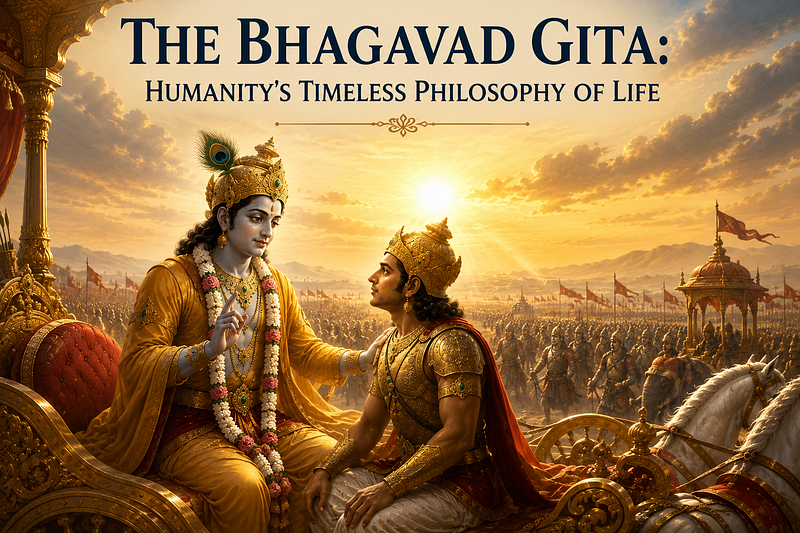
The Shrimad Bhagavad Gita is a jewel embedded within the Bhishma Parva of the monumental epic Mahabharata. Set dramatically upon the battlefield of Kurukshetra right as a tragic civil war looms, it records the high psychological and philosophical dialogue between the despondent warrior Arjuna and Sri Krishna, acting as his charioteer. Comprising 18 chapters and 700 verses, the Gita functions as a brilliant text of existential psychology, showing how to navigate deep moral paralysis and identity crises.
Part I: The Chronological Frame
A. Dr. Sarvepalli Radhakrishnan
“The composition of the Gita may be assigned to the fifth century BCE. It is earlier than the later developments of the systems of philosophy and reflects the spirit of the Upanishads.” Reference: Radhakrishnan, S. (1948). The Bhagavadgita. London: George Allen & Unwin Ltd. (p. 14).
B. Bal Gangadhar Tilak
“The Gita must have been written at least 500 years before the Christian era, and its teachings are older still, dating back to the period of the Mahabharata war, which took place around 1400 BCE.” Reference: Tilak, B. G. (1915). Srimad Bhagavadgita Rahasya. Poona: Tilak Bros. (pp. 734-738).
C. R. G. Bhandarkar
“The Bhagavadgita is older than the rise of Buddhism or at least contemporary with its earliest phase, and it cannot be placed later than the 4th century BCE.” Reference: Bhandarkar, R. G. (1913). Vaishnavism, Shaivism and Minor Religious Systems. Strassburg.
D. Arthur Anthony Macdonell
“The Bhagavadgita, as part of the Mahabharata, in its present form, was probably composed around the second century BCE, though its core teachings are much older.” Reference: Macdonell, A. A. (1900). A History of Sanskrit Literature. London. (p. 285).
Part II: Core Teachings
A. Effort Freed from Anxiety (Nishkama Karma)
- Sanskrit (Roman): Karmany-Eva-Adhikaraste Ma Phaleshu Kadachana, Ma Karmaphala-Hetur-Bhur-Ma Te Sango-Astva-Karmani. (2.47)
- English Translation: “You have a right to perform your prescribed duties, but you are never entitled to the fruits of your actions. Let not the fruits of action be your motive, nor let your attachment be to inaction.” — (Adapted from Swami Nikhilananda / Eknath Easwaran)
- Philosophical Significance: This is a masterful psychological key for stress release. It unburdens human effort by training the mind to focus completely on the excellence of the present step (the process) while letting go of the exhausting worry over future outcomes (the result), avoiding both the paralysis of anxiety and the slide into laziness.
- B. The Indestructible Self
- Sanskrit (Roman): Nainam Chhindanti Shastrani Nainam Dahati Pavakah, Na Chainam Kledayanty-Apo Na Shoshayati Marutah. (2.23)
- English Translation: “Weapons cannot cleave this Self, fire cannot burn It, water cannot wet It, and wind cannot dry It.” — (Adapted from Juan Mascaró / Penguin Classics)
- Philosophical Significance: By revealing that the innermost core of awareness (Atman) is completely immune to material destruction or earthly trauma, this verse cuts through existential dread. It drops the individual into a reservoir of deep internal security that remains steady through life’s storms.
- C. The Call to Absolute Self-Reliance
- Sanskrit (Roman): Uddhared-Atmana-Atmanam Natmanam-Avasadayet, Atmaiva Hy-Atmano Bandhur-Atmaiva Ripur-Atmanah. (6.5)
- English Translation: “Let a man lift himself by his own Self, let him not degrade himself. For the Self alone is the friend of oneself, and the Self alone is one’s own enemy.” — (Adapted from Sri Aurobindo)
- Philosophical Significance: This teaching returns absolute agency to the individual. It reveals that our inner state of mind is the true author of our freedom or imprisonment; a mind refined and guided acts as an ultimate ally, while an undisciplined, reactive mind behaves as a silent enemy within.
- D. The Balance of Cosmic Restoration
- Sanskrit (Roman): Yada Yada Hi Dharmasya Glanir-Bhavati Bharata, Abhyutthanam-Adharmasya Tadatmanam Srijamy-Aham. (4.7)
- English Translation: “Whenever and wherever there is a decline in righteousness, O Arjuna, and a rise in unrighteousness—at that time I manifest Myself.” — (Adapted from Swami Prabhupada)
- Philosophical Significance: This statement tracks a structural law of balance. It assures humanity that whenever the moral and systemic order of society faces severe decline, an equal, restorative force naturally awakens within the cosmic matrix to reset evolutionary balance.
- E. The Clarifying Flame of Wisdom
- Sanskrit (Roman): Na Hi Gyanena Sadrisham Pavitram-Iha Vidyate, Tat Svayam Yogasamsiddhah Kalena-Atmani Vindati. (4.38)
- English Translation: “In this world, there is nothing so purifying as wisdom/knowledge. One who becomes perfect in yoga finds that knowledge within oneself in due course of time.” — (Adapted from SAKSI Trust)
- Philosophical Significance: Wisdom is given the highest honor here, crowned above blind ritualism or performative gestures. True knowledge is a slow, beautiful purification that washes the lens of the mind, melting away ignorance and restoring clarity from within.
- F. The Dissolution of Past Baggage
- Sanskrit (Roman): Yathaidhamsi Samiddho-Agnir-Bhasmasat Kurute-Arjuna, Gyanagnih Sarvakarmani Bhasmasat Kurute Tatha. (4.37)
- English Translation: “As a blazing fire turns firewood to ash, O Arjuna, so does the fire of knowledge reduce all actions (and their karmic bonds) to ashes.” — (Adapted from Wendy Doniger)
- Philosophical Significance: This points to the massive, liberating power of a sudden perspective shift. It teaches that when an individual connects with deeper truth, the heavy psychological residue of past errors and generational conditioning is instantly dissolved, giving them a fresh, unburdened present.
- G. The Danger of Internal Division
- Sanskrit (Roman): Agyash-Chashraddadhanash-Cha Samshay Atma Vinashyati, Nayam Loko-Asti Na Paro Na Sukham Samshayatmanah. (4.40)
- English Translation: “But the ignorant, the faithless, and the doubting self go to destruction. For the doubting soul, there is happiness neither in this world nor in the world beyond.” — (Adapted from R.C. Zaehner)
- Philosophical Significance: This serves as an intuitive critique of chronic indecisiveness and fragmented intent. It warns that a mind locked in continuous skepticism and self-doubt cancels out its own power, stranding the individual in an anxious stagnation where execution and peace are lost.
- H. Yoga as Graceful Execution (Skill in Action)
- Sanskrit (Roman): Buddhiyukto Jahateeha Ubhe Sukrita-Dushkrite, Tasmad-Yogaya Yujyasva Yogah Karmasu Kaushalam. (2.50)
- English Translation: “One who is established in equanimity casts aside both good and evil deeds in this life. Therefore, strive for Yoga; Yoga is skill in action.” — (Adapted from SAKSI Trust)
- Philosophical Significance: This text beautifully transforms the definition of Yoga. Moving it away from ascetic flight, it redefines spiritual practice as executing our daily duties with absolute precision, elegance, and balance, identifying focused work as a living dance of mindfulness.
- I. The Stream of Action over Inertia
- Sanskrit (Roman): Niyatam Kuru Karma Tvam Karma Jyayo Hy-Akarmanah, Sharirayatra Pi Cha Te Na Prasidhyed-Akarmanah. (3.8)
- English Translation: “Perform your prescribed duty, for action is far better than inaction. Even the maintenance of your physical body would be impossible without action.” — (Adapted from Abinash Chandra Bose)
- Philosophical Significance: A firm stand against lazy resignation and fatalism. The Gita insists that life itself is a movement of continuous activity, commanding humanity to contribute its unique, active share to the keeping of the social and planetary balance.
- J. The Standard of Leadership
- Sanskrit (Roman): Yadyad-Acharati Shreshthas-Tattad-Eva-Itaro Janah, Sa Yat Pramanam Kurute Lokas-Tadanu Vartate. (3.21)
- English Translation: “Whatever actions a great man performs, common people follow. And whatever standards he sets by his exemplary acts, all the world pursues.” — (Adapted from Modern Management Translations)
- Philosophical Significance: This is a cornerstone teaching on authority. It outlines that true leaders do not manage through hollow words, but through the transparent integrity of their personal lives. The standard they create through direct action sets the ethical compass for the whole culture.
- Part III: Testimonials on the Gita
- Mahatma Gandhi:
- “When doubts haunt me, when disappointments stare me in the face, and I see not one ray of hope on the horizon, I turn to Bhagavad Gita and find a verse to comfort me; and I immediately begin to smile in the midst of overwhelming sorrow.” Reference: The Collected Works of Mahatma Gandhi, Vol. 28, p. 27. (Originally published in Young India, 1925).
- Henry David Thoreau:
- “In the morning I bathe my intellect in the stupendous and cosmogonal philosophy of the Bhagavad Gita, in comparison with which our modern world and its literature seem puny and trivial.” Reference: Thoreau, H. D. (1854). Walden; or, Life in the Woods. Boston: Ticknor and Fields. (Chapter 16: “The Pond in Winter”).
- Ralph Waldo Emerson:
- “I owed a magnificent day to the Bhagavad Gita. It was the first of books; it was as if an empire spoke to us, nothing small or unworthy, but large, serene, consistent, the voice of an old intelligence.” Reference: The Letters of Ralph Waldo Emerson, Vol. 3, p. 290. (Personal letter, 1845).
- J. Robert Oppenheimer:
- “If the radiance of a thousand suns were to burst at once into the sky, that would be like the splendor of the mighty one… Now I am become Death, the destroyer of worlds.” Historical Reference: Oppenheimer’s historical NBC News Documentary Interview, 1965 (Recalling the Trinity Test nuclear blast on July 16, 1945). Linguistic Note: Oppenheimer synthesized verses 12 and 32 of Chapter 11 (The Viswarupa-Darshana) to capture his thoughts. He translated the rich Sanskrit term Kala as “Death” instead of “Time” or “Cosmic Order”—drawing a profound, haunting link between the blind, consuming force of time described by Krishna and the total, atomic force unleashed by human science.
- FINAL CONCLUSION
While philological layers trace the physical compilation of the Shrimad Bhagavad Gita to the centuries between the 5th and 2nd BCE, traditional frameworks place its spiritual birth at the dawn of the Dwapara Yuga’s end (circa 3102 BCE).
Ultimately, these chronological details confirm a beautiful reality: the ancient literature of India—stretching from the wild nature hymns of the Rigveda, through the deep internal mirror of the Upanishads, to the actionable psychology of the Bhagavad Gita—is not a collection of local dogmas. It is an open, sovereign monument of human introspection. By addressing the permanent mechanics of mind, focus, and nature, these independent texts remain a deep source of universal insight, reminding humanity that the awakening of conscious awareness is our highest purpose.