Why Does the Panchatantra Remain a Wonder of World Literature?
Behind its animal tales lie timeless lessons in human nature, friendship, leadership, diplomacy, and practical wisdom
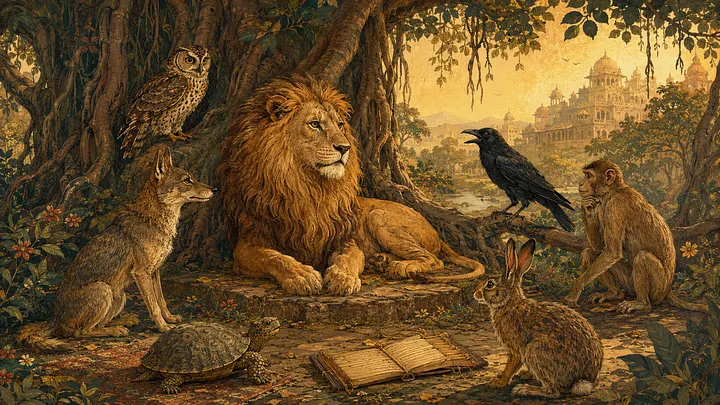
For more than two thousand years, one collection of stories has continued to fascinate readers across the world. Transcending the boundaries of language, culture, and geography, that extraordinary work is the Panchatantra.
According to tradition, the learned scholar Vishnu Sharma composed it in ancient India to teach young princes wisdom, leadership, diplomacy, and practical judgment. Over time, however, this instructional work became an invaluable treasure of world literature.
Life and Human Nature Behind the Stories
In the Panchatantra, lions, jackals, crows, owls, monkeys, tortoises, and hares speak, make plans, form friendships, become entangled in conspiracies, make mistakes, and sometimes escape danger through their own intelligence. Although they appear to be animal tales, the characters are really reflections of human beings.
The true subjects of these stories are human greed, fear, ambition, trust, betrayal, foolishness, foresight, and the desire for power. Children may enjoy them as delightful fables, while adults discover subtle lessons about life, society, and politics.
The Panchatantra rarely imposes its teachings as direct moral instruction. Through the actions, errors, ingenuity, and consequences experienced by its characters, readers arrive at their own understanding. This is the source of its artistic power: it entertains, cautions, and teaches us to think at the same time.
Stories Within Stories
One of the work’s most distinctive features is its frame-narrative technique — stories within stories. A character in the main narrative tells a tale, and another story may begin inside that tale. In this way, the stories become interconnected and form a larger narrative whole.
This technique not only sustains the reader’s interest but also allows the same idea to be explored through different situations and perspectives. The Panchatantra is therefore more than a collection of moral tales; it is also a remarkable example of an ancient yet highly sophisticated art of storytelling.
The Five Books of the Panchatantra
The word Panchatantra means ‘Five Treatises’ or ‘Five Books.’ Although the number and arrangement of stories vary among manuscripts and versions, its fundamental structure consists of five divisions.
1. Mitrabheda — The Loss of Friends
This book concerns conflict and separation between friends. It shows how rumours, flattery, conspiracy, rivalry for power, and distrust can destroy a good relationship.
2. Mitralabha — The Gaining of Friends
Its central theme is gaining and preserving friendship. The stories demonstrate how cooperation, loyalty, resourcefulness, and unity can enable even the weak to overcome great dangers.
3. Kakolukiyam — Of Crows and Owls
Centred on the conflict between crows and owls, this book explores warfare, alliances, espionage, strategy, diplomacy, and the difficult art of choosing friends and enemies.
4. Labdhapranasham — The Loss of Gains
These stories show how wealth, relationships, or success acquired through great effort may be lost through carelessness, greed, or poor judgment.
5. Aparikshitakarakam — Ill-Considered Action
The final book examines the dangers of acting without verification or without considering the consequences. Decisions driven by emotion, suspicion, or haste can cause damage that may never be repaired.
Wisdom, Ethics, and Practical Judgment
To describe the Panchatantra merely as a book of moral instruction is to overlook its range. Alongside ethical ideals, it gives serious attention to the difficult realities of life.
When should a friend be trusted? When is it wise to make peace with an enemy? How can danger be recognised, and how can intelligence overcome strength? These are among the questions the work explores.
It teaches that physical strength and social status alone do not guarantee success. In many situations, presence of mind, self-control, sound advice, and the ability to understand circumstances are a person’s greatest strengths. This practical outlook gives the Panchatantra a depth that extends far beyond conventional moral tales.
The Panchatantra’s Journey Through World Literature
From ancient India, the stories of the Panchatantra travelled across regions and civilisations through a long chain of translations. The Sanskrit work was translated into Pahlavi, and its later Arabic adaptation became widely celebrated as Kalila wa Dimna.
Through Arabic and Persian versions, the stories entered Hebrew, Latin, and several European languages. During this long journey, names, settings, and cultural details often changed, but the essential wisdom of the stories endured.
Many of its tales directly or indirectly influenced later folklore, fables, and children’s literature. For this reason, the Panchatantra remains an important source for comparative literary studies and for tracing the international circulation of stories.
World literature contains other renowned collections of moral and animal tales, including Aesop’s Fables and the Jataka Tales. Yet the Panchatantra remains distinctive in the way it brings animal narrative, human psychology, statecraft, diplomacy, and stories within stories together in one organised literary structure.
Why Is It Still Relevant?
Ages have changed, and the structures of society and government have been transformed, but fundamental human impulses have not disappeared. People still form friendships, fall victim to deception, struggle for power, become misled by rumours, make rash decisions, and rely on intelligence and cooperation to escape danger.
That is why the tales of the Panchatantra do not feel confined to the ancient world. Their insights readily apply to modern family life, workplaces, politics, leadership, and personal relationships.
Conclusion
The Panchatantra is a book that delights children, yet it is also a profound school of human nature, relationships, leadership, and practical life for adults. Its stories make us laugh and wonder, while also warning us about human errors and weaknesses.
A work that continues to speak afresh to human experience across time and language is a true classic. The Panchatantra is one of those rare literary achievements — an inheritance from the past that remains a timeless guide for the present and the future.